 by
Groin Strain Physiotherapy in Morinville: Heal Strong and Return to Sport Safely
Intro
Groin strain physiotherapy Morinville hockey players, soccer players, and runners ask about usually starts with one fast movement: you cut sideways on the ice, reach for a loose puck, strike a ball, or sprint off the line, and feel a sharp pull high on the inside of your thigh. One stride you are fine. The next stride you cannot bring your leg in, speed up, or kick without pain. It happens in rec hockey, soccer, running, gym training, and weekend work across Morinville.
The good news is that most groin strains heal well with the right plan. The frustrating part is that groin strains also come back easily if you rush back. A groin that feels fine at walking pace can still be far from ready for sprinting, cutting, or kicking. This guide explains what a groin strain is, how the grades work, what to do in the first few days, how groin strain physiotherapy Morinville care at Healrise Physiotherapy and Wellness rebuilds inner thigh strength step by step, and how to return to running and sport without tearing it again.
Table of Contents
Table of Contents
What Is a Groin Strain?
Your groin is the area where your thigh meets your pelvis. The muscles that run along the inside of your thigh are called the adductors. There are six of them, including the adductor longus, adductor brevis, adductor magnus, gracilis, and pectineus. Their main job is to bring your leg in toward the middle of your body, a movement called adduction. They also help steady your pelvis and leg every time you run, skate, kick, cut sideways, or change direction.
The adductor longus is strained most often. It attaches near your pubic bone, so pain is usually felt high in the groin or along the upper inner thigh. Pain right at that attachment often takes longer to settle than pain further down the thigh.
A groin strain, often called a pulled groin, happens when inner thigh fibres are stretched beyond what they can handle and tear. Adductors work hardest when they lengthen under load, as in a sideways push-off, a hard crossover, or a kick. That stretch plus force is where most groin strains happen. The biggest recovery factor is the grade.
Grade 1: mild strain. Only a small number of fibres are overstretched, with no visible tear. You feel a definite twinge or tightness in the inner thigh, you can usually still walk, and your strength is close to normal. Grade 1 strains settle quickest, often within 2 to 3 weeks with proper care.
Grade 2: partial tear. A larger portion of the muscle is disrupted, with clear pain, reduced strength when you squeeze your legs together, a limp, and sometimes bruising a day or two later. This is a common grade we see in Morinville athletes. It needs a staged rebuild and commonly takes 3 to 6 weeks before a graded return to sport.
Grade 3: severe or complete tear. The muscle tears fully, or in some cases the tendon pulls away from the bone, which is called an avulsion. Pain is intense, walking is very difficult, and bruising and swelling are heavy. Grade 3 tears need prompt medical assessment within 1 to 2 days to decide whether imaging or a surgical opinion is needed. Recovery is usually measured in months, often around 3 months, not weeks.
Only an in-person assessment can grade your strain properly and tell which adductor muscle is involved.
Symptoms of a Groin Strain
A groin strain usually announces itself clearly. The most common signs are:
Sudden pain in the inner thigh or groin. A sharp pull, grab, or pop during a sideways push-off, a kick, a sprint start, or a sudden change of direction. Many people can point to the exact spot with one finger, often high in the groin or along the upper inner thigh.
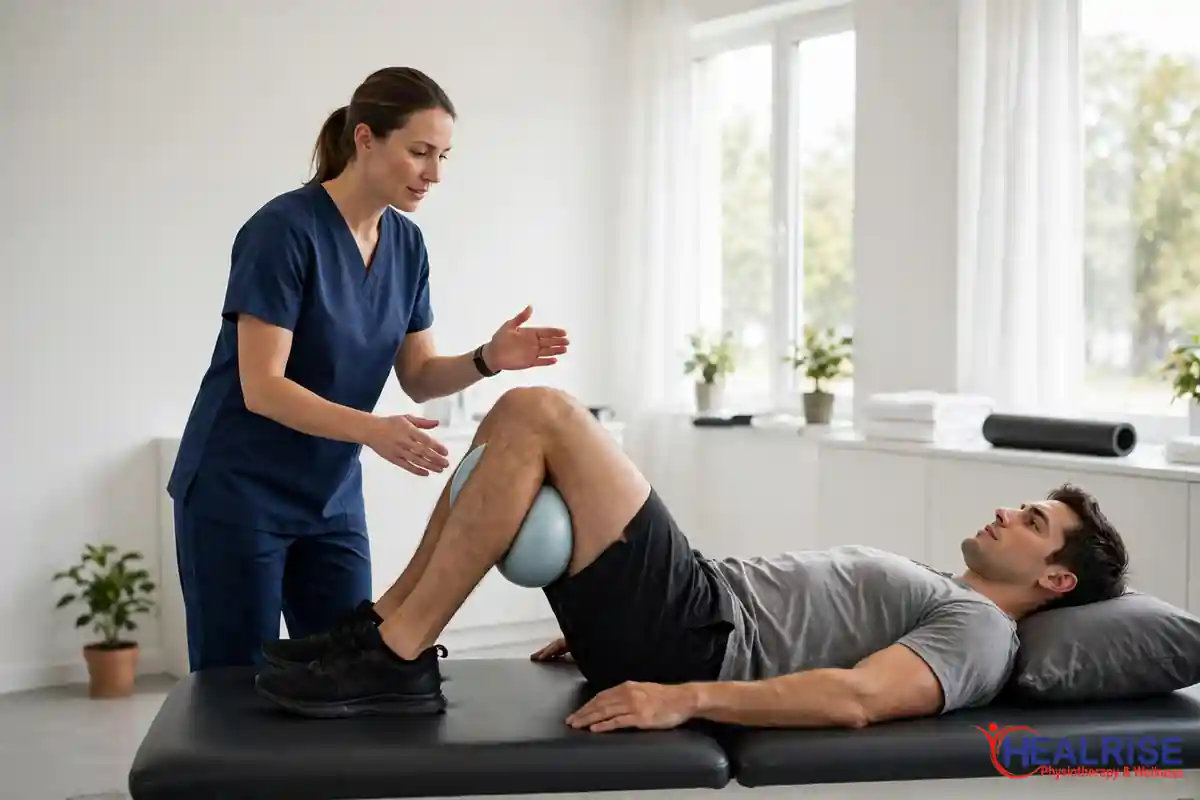
Pain when you bring your leg in or squeeze your knees together. Squeezing against a ball loads the adductors and reproduces the pain. This squeeze test is a key check your physiotherapist uses.
Pain when you speed up, kick, or cut sideways. Sprinting, kicking, or changing direction on the ice is painful or feels weak.
Tenderness, weakness, and stiffness. The injured spot is sore when pressed, especially near the pubic bone. The leg feels weak bringing it in, and the groin is stiff after resting.
Bruising, swelling, and a limp. Bruising often appears within 24 to 72 hours with grade 2 and 3 strains. You shorten your step and avoid pushing off sideways.
If two or more sound familiar, assessment comes before loading.
What Causes Groin Strains?
Groin strains rarely happen by pure bad luck. Usually several factors stack up until one cut, kick, or sprint is the final straw. The main contributors are:
Sudden sideways push-off and kicking. Sports with rapid acceleration, deceleration, sharp direction changes, and forceful kicking load the adductors hardest. Hockey, soccer, rugby, and basketball are the classic settings, especially when you are tired late in a game.
Weak adductor muscles. Inner thigh muscles that are weak, especially when lengthening under control, cannot absorb cutting and kicking forces. Previous groin injury is the strongest risk factor: a strained groin is far more likely to strain again, especially in the first weeks back. A large strength gap between the adductors and the outer hip muscles also raises risk.
Fatigue and poor load management. Most strains happen late in a game or after a sudden jump in training: a full match after weeks off, extra ice time, or speed work spikes load faster than the muscle can adapt.
Tightness and limited hip movement. Stiff hips force the adductors to work harder through a smaller range. Weak glutes and trunk matter too: when they do not share the work of steadying the pelvis, the adductors take more load.
Age and cold muscles. Strains become more common as elasticity declines with age. Sprinting or skating hard on cold muscles, especially in an Alberta winter, raises risk further. A new surface or different skates or shoes can also suddenly change groin load.
These causes mean the muscle must be rebuilt stronger, in the exact positions where it tore. That is what physiotherapy does.
Groin Strain or Something Else? How Diagnosis Works
Groin pain is a location, not a single diagnosis. An international consensus divides it into five overlapping categories: adductor, iliopsoas, inguinal, pubic, and hip joint. A groin strain physiotherapy Morinville assessment at Healrise sorts out which apply to you, because treatment differs for each.
Diagnosis starts with your story: how it happened, where it hurts, and what makes it better or worse. For an adductor strain, your physiotherapist checks three things together: tenderness at the adductor attachment near the pubic bone, pain when you squeeze your legs together against resistance, and pain on the squeeze test with a ball between your knees. Hip movement, strength, and walking are checked too, along with your knee, ankle, and lower back.
Hip joint problems. Deep groin pain that feels inside the joint, with clicking, catching, or limited hip rotation, often comes from the hip joint itself rather than the adductors. Our guide to hip pain physiotherapy in Morinville explains how hip joint pain differs from a muscle strain and how it is rehabbed.
Iliopsoas-related pain. Pain at the front of the hip that hurts when you lift your knee against resistance or stretch the hip into extension points to the hip flexor rather than the adductors.
Inguinal-related pain and hernia. Pain in the groin crease that worsens with coughing, sneezing, or sitting up can be inguinal-related groin pain, sometimes loosely called a sports hernia. A true hernia may show a lump that changes with coughing or straining. If a hernia is suspected, you will be referred to your physician.
Pubic-related pain. Tenderness right at the pubic bone and the joint between the two halves of the pelvis, often in athletes with long-standing groin pain, needs its own load-management approach.
Other leg injuries. Groin strains often come with other problems. Pain at the back of the thigh is more likely a hamstring strain, covered in our guide to hamstring strain physiotherapy in Morinville. Pain at the back of the lower leg after a push-off is more likely a calf strain, covered in our guide to calf strain physiotherapy in Morinville. Knee pain that changes how you run or skate is covered in our guides to knee pain physiotherapy in Morinville and runner’s knee treatment in Morinville. Back pain that refers into the groin and thigh is covered in our guide to back pain physiotherapy in Morinville. Our guide to sports injury physiotherapy in Morinville covers how we assess and rehab the full range of sports injuries. Tell your physiotherapist about every ache, not just the groin, so we fix the whole chain.
Imaging is rarely needed for a straightforward grade 1 or 2 strain; diagnosis comes from history, palpation, and strength testing. Imaging is used when the diagnosis is unclear, when a complete tear or avulsion is suspected, or when a stress fracture of the hip needs ruling out. An early X-ray can look normal for a stress fracture, so worsening groin pain in a runner that builds with each run needs same-day medical assessment.
Groin Strain Physiotherapy Morinville: How Treatment Works
Physiotherapy is the main treatment for groin strains, and the evidence behind progressive strengthening is strong. Clinical commentary on groin pain in athletes, published in the Journal of Orthopaedic and Sports Physical Therapy, supports early gentle movement, then progressive strengthening, then a graded return to running and sport. Most small to moderate strains return to full training in about 3 weeks with criteria-based rehab, while complete tears usually take around 3 months. Rest alone is not enough: a muscle that is fully rested heals weaker and less organized, and re-injury rates are high when people return on feel alone.
Here is what treatment at Healrise usually includes:
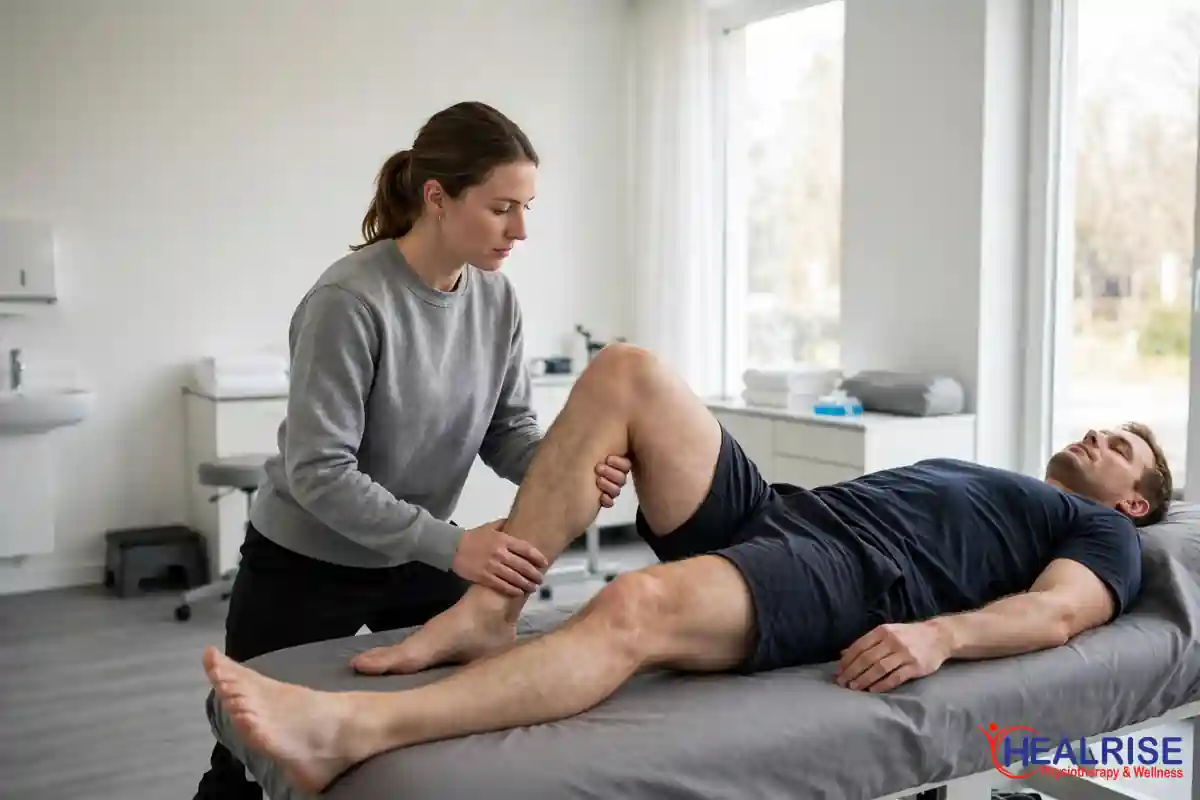
A full assessment and grading. Your physiotherapist asks how it happened, checks where the pain sits, feels for tenderness near the pubic bone and along the inner thigh, and tests squeeze strength, hip movement, and walking. Your knee, ankle, hip, and lower back are checked too.
Calming the muscle down in the first few days: the PRICE approach. The early goal is to protect the tear without shutting the muscle away completely. For the first 48 to 72 hours, follow PRICE: Protect the leg by avoiding sprinting, kicking, and sharp sideways movements; Rest relative to the injury, meaning easy walking only; Ice for comfort, 15 to 20 minutes at a time with a barrier on the skin; Compression with snug shorts or a wrap to limit swelling; and Elevation, raising the leg when you can. Gentle, pain-free movement is encouraged after the first 2 to 3 days: lightly used muscle heals better than fully rested muscle. One clear warning: do not forcefully stretch a freshly torn groin to try to loosen it. Pulling hard on torn fibres can enlarge the tear.
Progressive strengthening, stage by stage. This is the heart of groin strain physiotherapy Morinville care. Stage one uses isometric squeeze holds to switch the adductors back on safely. Stage two adds movement through range, including side-lying lifts and the Copenhagen progression. Stage three builds loaded eccentric strength, key for preventing re-injury. Stage four adds running, cutting, kicking, and skating drills at increasing speed. You advance only when the current stage is comfortable and strength checks are met, not on a fixed calendar.
Hands-on care and movement retraining. Soft tissue work, gentle mobilization, and taping can ease pain while strength rebuilds. Your physiotherapist also retrains walking, running, and skating mechanics so load is shared properly across the hip and trunk.
Timelines vary by grade. Grade 1 strains often return to sport in 2 to 3 weeks. Grade 2 strains commonly need 3 to 6 weeks. Grade 3 tears and avulsions usually take around 3 months and may need specialist input. Full sprinting, cutting, and kicking usually return later than you feel ready for, and that gap is where people get caught out.
Exercises for Groin Strain Recovery
The exercises below are the ones most often used in groin strain physiotherapy Morinville programs. They are described so you know what to expect, not as a do-it-yourself prescription. Start any program under a physiotherapist’s guidance, keep pain mild and never sharp during exercise, and stop any movement that causes a sudden pull, swelling, or limping afterward. Warm up first with easy walking or a stationary bike.
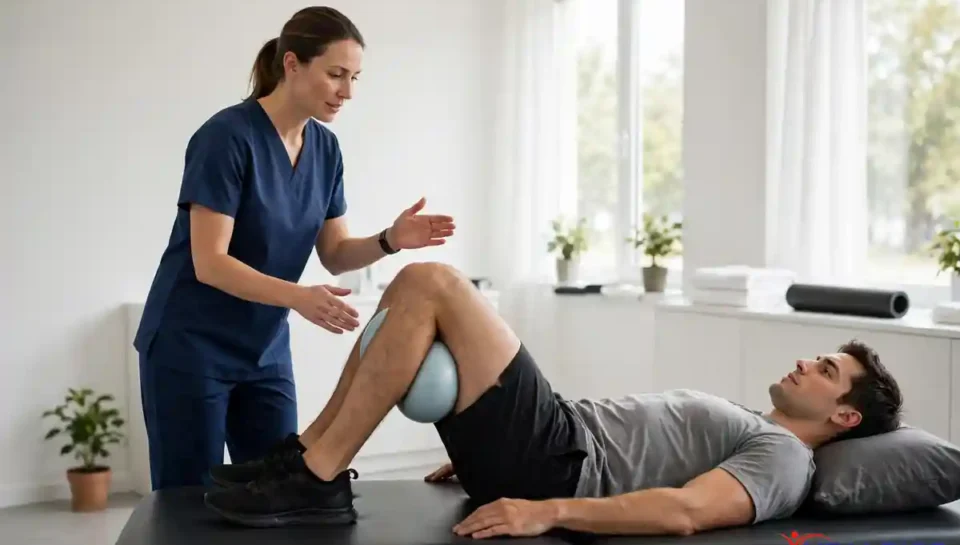
Isometric ball squeezes (early phase). Lie on your back with knees bent and a soft ball between your knees. Squeeze gently at well below full effort, hold about 20 seconds, then relax. Repeat about 5 times, once or twice daily in week one. These static contractions load the muscle safely without lengthening. Once comfortable, the same squeeze with legs straight loads through a longer lever.
Side-lying inner thigh lifts. Lie on your side with your bottom leg straight. Lift the bottom leg up through a short, pain-free range, then lower slowly. Do 2 sets of 8 to 10 on each side. This builds basic adductor strength before harder work.
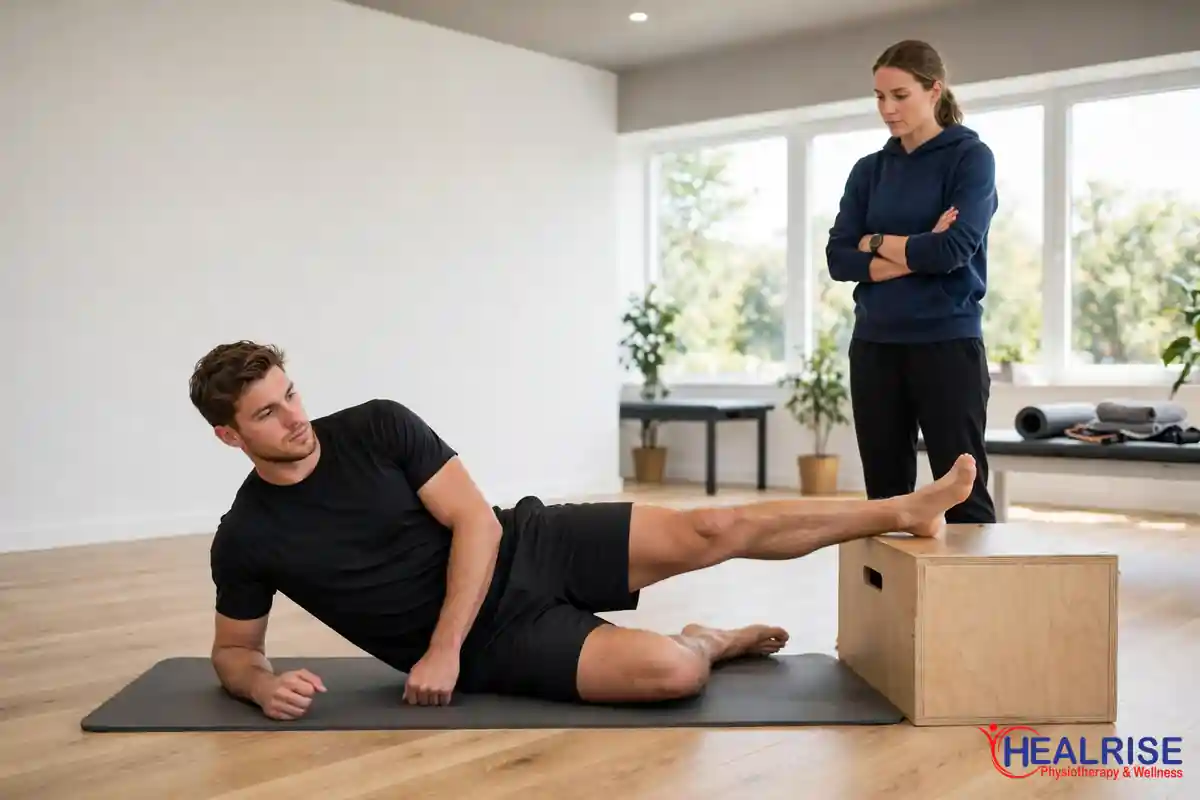
Copenhagen adductor exercise, Level 1 (beginner). Lie on your side on a mat with your top leg supported at the knee on a bench or sturdy chair. Lift your bottom leg up to meet the bench while raising your hips slightly, hold for 2 seconds, then lower under control. Do 2 sets of 10 on each side. Supporting at the knee keeps the load manageable.
Copenhagen adductor exercise, Level 2 (medium). Same setup, but support the top leg at the ankle instead of the knee. The longer lever places greater load on the adductors. Do 2 sets of 8 on each side. Move to this level only when Level 1 is comfortable.
Copenhagen adductor exercise, Level 3 (hard). The full version, where a partner holds your top ankle while you raise and lower your whole body slowly, controlling the descent. Do 3 sets of 8 to 10. This eccentric loading, where the muscle produces force while lengthening, is the most important stage for preventing re-injury, because it rebuilds strength in the exact position where groins tear. In one trial of male soccer players, a Copenhagen program done three times a week in preseason and once a week in season lowered the risk of reporting groin problems by 41 percent.
Hip and trunk work. Glute strengthening, single-leg balance, and trunk control share the load of steadying your pelvis, so the adductors do not work alone.
What to avoid for now. Sprinting, kicking, hard cutting, and deep groin stretching load healing fibres heavily. They are paused, not banned, then reintroduced one at a time. Easy cycling and flat walking keep you fit without flaring the injury. Avoid returning too soon, stretching hard, and skipping the Copenhagen progression.
Consistency beats intensity.
Returning to Running and Sport
Returning too early is the usual reason groin strains come back. Being pain-free at rest is not enough on its own: returning while still weak is a common reason for re-injury. At Healrise, you move through clear stages, and each stage must be cleared before the next.
Straight-line jogging comes first, once walking is pain-free and squeeze holds at moderate effort do not hurt. Light jogging starts once hopping on the injured leg is symptom-free. Keep pain at 3 out of 10 or less during activity, with no increase the next day. Then come faster running, change of direction, kicking or skating drills, then full training. Before full return, adductor strength should be within about 10 percent of the other side, with no pain on squeeze testing, full hip movement, and full-speed sprints, cuts, kicks, and crossovers completed pain-free. A graded return over weeks protects you far better than a single test game.
What to Expect at Healrise
Your first visit is an assessment, usually about an hour. Your physiotherapist will ask how it happened, where it hurts, and your goal: work, running, hockey, soccer, or the gym. Bring any imaging reports. Then comes the physical assessment: tear location, squeeze strength, hip movement, and walking quality. You will leave with your grade explained and a staged plan.
You do not need a referral to book. Most extended health benefit plans in Alberta cover physiotherapy, and direct billing is available for many plans. Healrise Physiotherapy and Wellness is at Unit 101, 10507 100 Ave, Morinville, Alberta, T8R 1A2. Call 587-485-0787 or book online through healrisephysiotherapy.ca.
Groin strain physiotherapy Morinville care at Healrise is honest about timelines. We cannot promise you will sprint and cut pain-free in a week after a grade 2 tear. We can promise a proper assessment, a progressive program matched to your grade, and clear return-to-sport testing, including checking that your adductor strength matches the other side, so you go back when the muscle is ready, not just when it feels okay.
When to See a Doctor Urgently
Most groin strains are safe to manage with physiotherapy over weeks. But some signs need prompt medical care. Go to urgent care or the hospital, or call your doctor the same day, if you notice:
A sudden pop with severe pain, and you could not carry on. This can indicate a complete tear or a tendon pulled off the bone. See a doctor within 1 to 2 days to decide whether imaging or a surgical opinion is needed.
Extensive bruising spreading down the thigh within 24 hours. This points to a high-grade tear that needs medical assessment in the next few days.
A groin lump with sudden severe pain, vomiting, or difficulty passing stool or wind. This can be a trapped hernia, which needs emergency assessment.
Sudden severe testicular pain or swelling. Do not treat this as a groin strain. Go to emergency now.
Groin or hip pain in a runner that builds with each run, pain when hopping, night pain, or a limp. This can be a stress fracture of the hip. Stop running and all impact exercise, keep weight off the leg, and get medical assessment today.
Fever with groin pain or a hot, swollen hip. This can be a joint infection. Go to emergency now.
A limping child or teenager with hip, groin, thigh, or knee pain. Growing-bone hip problems need excluding urgently. Do not let the child walk on the leg; seek emergency assessment today.
Numbness, weakness, or inability to move the leg or bear weight. Loss of function after an injury always deserves medical review.
Also book soon if pain is not improving after 2 weeks of appropriate rehab, or the same groin keeps pulling when you play.
Preventing Groin Strains From Coming Back
Once the pain settles, the goal is to keep it settled. Groin strains have a high re-injury rate, mostly in the first weeks back when the muscle feels fine but is not yet strong. Keep these habits year-round, especially through Alberta winters.
Keep Copenhagen adductor work in your routine. Progressed gradually, it best protects the muscle in its lengthened position. Once a week in season is a common maintenance dose.
Build load gradually and warm up properly. Increase load by roughly 10 percent per week at most, adding sprinting, cutting, and kicking one at a time. Warm up with 5 to 7 minutes of easy movement; never go full speed cold.
Train the hips and trunk, and respect fatigue. Strong glutes, mobile hips, and trunk control reduce adductor load. Most tears happen when tired, so stop when form breaks down.
Do not skip the return-to-sport steps. Walk, jog, run, sprint, cut, kick, full training: in that order, pain-free at each step, with adductor strength matching the other side before full return.
Groin strain physiotherapy Morinville programs at Healrise finish with a prevention plan, because getting you pain-free is only half the job. Keeping you playing is the other half.
Frequently Asked Questions
How long does a groin strain take to heal?
It depends on the grade. Grade 1 often allows a graded return within 2 to 3 weeks. Grade 2 commonly takes 3 to 6 weeks. Grade 3 tears and avulsions usually take around 3 months and may need specialist input. Most small to moderate strains return to full training in about 3 weeks with criteria-based rehab, but full sprinting, cutting, and kicking return later than daily activity.
Should I stretch a pulled groin?
Gentle, pain-free movement helps, but aggressive stretching of a freshly torn muscle does not: it can enlarge the tear. Avoid deep groin stretching in the first few days. Focus on gentle movement and progressive strengthening, especially isometric squeezes early and the Copenhagen progression later. Flexibility work returns later, dosed to comfort.
When can I run and play again after a groin strain?
Only once walking is pain-free, squeeze holds at moderate effort do not hurt, and hopping is symptom-free. Progress from straight-line jogging to faster running, cutting, kicking or skating drills, then full training. Before full return, adductor strength should match the other side within about 10 percent, with no pain on squeeze testing.
Is a groin strain the same as a sports hernia?
No. A groin strain is a tear or overstretch of the inner thigh adductor muscles, tender along the inner thigh and worse when you squeeze your knees together. The term sports hernia is used loosely for inguinal-related groin pain in the groin crease, worse with coughing, sneezing, or sitting up, and it does not involve a true hernia. A true hernia may show a lump that changes with coughing and needs a medical opinion. Your assessment checks for both.
Should I use ice or heat on a groin strain?
In the first 48 hours, ice helps pain and swelling, 15 to 20 minutes at a time with a barrier on the skin. Avoid heat early, as it can increase bleeding into the tear. Later, gentle heat before exercise can ease stiffness but never replaces strengthening. Stop either if sharp pain increases.
Do I need a referral to book physiotherapy in Morinville, and is it covered by insurance?
No referral is needed; book directly with Healrise Physiotherapy and Wellness. Bring imaging or a referral letter if you have them, but they are not required. Most Alberta extended health plans cover physiotherapy, often with direct billing. Work injuries may be covered by WCB Alberta, and motor vehicle accidents by accident benefits. Our front desk can confirm your coverage.
Disclaimer
This article is general information only, not medical advice. The right treatment depends on your own assessment and grade. Seek urgent care for a pop with severe pain, extensive bruising, a groin lump with severe pain or vomiting, sudden severe testicular pain, fever with groin pain, or groin pain in a runner that builds with each run. Speak with a physiotherapist or doctor before starting any exercise program.
Book Your Assessment
If that sharp pull in your groin still limits every stride, cut, and kick, assessment is the first step. Groin strain physiotherapy Morinville athletes and active people trust is available at Healrise Physiotherapy and Wellness. We will grade your strain, explain it in plain words, and build a staged plan to rebuild strength and return you to sport safely. No referral needed. Call 587-485-0787 or book online through healrisephysiotherapy.ca. Healrise Physiotherapy and Wellness is at Unit 101, 10507 100 Ave, Morinville, Alberta, T8R 1A2. Book an assessment today and take the first step toward healing strong and staying healed.