 by
Intro
Runner’s knee treatment Morinville runners ask about usually starts the same way: a dull ache around or behind the kneecap that shows up a few kilometres into a run, then lingers on the stairs at home. You might not run marathons. You might just run to stay fit, play rec hockey, hike on weekends, or chase your kids around the park. When the front of your knee aches every time you bend it, even sitting in a car or at a desk for too long, that pattern has a name: patellofemoral pain, often called runner’s knee.
The good news is that runner’s knee is one of the most treatable causes of knee pain. It is not usually a sign that your knee is worn out or that you need surgery. In most cases it is a load and strength problem: the kneecap is being pulled or pressed a little off track, and the tissues around it get irritated. With the right plan, most people get back to running, stairs, and squats without that front-knee ache. This guide explains what runner’s knee is, why it happens, how runner’s knee treatment Morinville care at Healrise Physiotherapy and Wellness works, and the exercises that actually help.
Table of Contents
Table of Contents
What Is Runner’s Knee (Patellofemoral Pain)?
Your kneecap, or patella, sits in a shallow groove at the front of your thigh bone. Every time you bend and straighten your knee, the kneecap glides up and down in that groove, guided by the big muscles at the front of your thigh, the quadriceps. The kneecap works like a pulley: it helps those muscles straighten your leg with more power when you walk, run, climb stairs, or stand up from a chair.
Patellofemoral pain means pain in and around that kneecap joint. It is very common. Research estimates it makes up about 23 percent of running injuries and is one of the most common knee complaints seen in sports medicine clinics. It affects runners, but also cyclists, gym-goers, students who sit for long hours, and anyone who suddenly does a lot more stairs, squats, or hill work than their knees are used to.
Unlike a sudden twist injury, runner’s knee usually builds up slowly. The pain is vague rather than sharp: a dull ache, pressure behind the kneecap, sometimes grinding or clicking. Many people push through it for weeks before getting help. Early runner’s knee treatment Morinville assessment can save you months of frustration, because the fix is about strength, load, and movement, and those take time to build.
Runner’s knee is not arthritis, a torn meniscus, or a torn ligament. Those can also cause knee pain, which is why a proper assessment matters. If your knee locks, gives way, swells a lot after an injury, or you cannot put weight on it, that needs prompt medical attention.
Symptoms of Runner’s Knee
Runner’s knee has a fairly clear pattern once you know what to look for. The most common signs are:
Pain around or behind the kneecap. A dull ache at the front of the knee, hard to point to with one finger. Some people describe it as pain under the kneecap. It often affects one knee more than the other, though both can hurt.
Pain that gets worse with bending. Running, especially downhill, going down stairs, squatting, kneeling, lunging, and sitting with your knees bent for a long time all tend to aggravate it. The “movie theatre sign” is classic: your knee aches after sitting through a film or a long drive, then eases once you straighten your leg and walk around.
Grinding, clicking, or creaking. Many people hear or feel a crackling sensation when they bend the knee. On its own, clicking without pain is usually harmless. With pain, it is worth getting checked.
Stiffness after rest. The knee feels stiff first thing in the morning or after sitting, then loosens up with gentle movement.
Pain that builds during activity. You might start a run feeling fine, then notice the ache creeping in after 10 or 15 minutes. If you keep pushing, it gets worse. If you stop, it settles within hours or by the next day.
If two or more of those sound familiar, runner’s knee is a likely cause, but only an in-person assessment can confirm it. Our broader guide to knee pain physiotherapy in Morinville explains how we sort out the different causes of knee pain at Healrise.
What Causes Runner’s Knee?
Runner’s knee rarely has one single cause. It is usually a combination of muscle weakness, tightness, training habits, and the way your leg lines up when you move. Think of it as your knee asking for more support than it is getting. The main contributors are:
Weak quadriceps, especially the inner quad. The quadriceps control the kneecap. The inner part, called the vastus medialis oblique or VMO, helps pull the kneecap slightly inward so it tracks smoothly. When the quads are weak, or the VMO fires a fraction of a second late, the kneecap can drift outward and press harder on the outer side of the groove. That extra pressure irritates the tissues and causes pain.
Weak hips and glutes. This is the piece most people miss. The muscles on the side and back of your hip, especially the gluteus medius, keep your thigh from rolling inward when you run or step down. When those hip muscles are weak, the thigh turns in, the knee caves slightly inward, and the kneecap gets pulled off track. Studies show people with patellofemoral pain often have hip muscles 20 to 30 percent weaker than pain-free people. That is why runner’s knee treatment Morinville programs at Healrise always include hip strengthening, not just knee exercises.
Tight muscles and the IT band. Tight quadriceps, hamstrings, calves, and a tight iliotibial band (the band of tissue running down the outside of your thigh) can all pull the kneecap sideways or limit how well the knee bends. The IT band is so often involved that it deserves its own mention: if your pain sits more on the outside of the knee, read our guide to IT band syndrome treatment in Morinville to see how the two conditions overlap and how we tell them apart.
Training load spikes. Doing too much, too soon is the classic trigger. A sudden jump in running distance, adding hill repeats, starting a squat-heavy gym program, or going from a desk job to a physical job all load the kneecap joint far more than it is used to. The joint can handle a lot, but it needs time to adapt. A useful rule is to increase your weekly load by no more than about 10 percent at a time.
Foot and ankle mechanics. Feet that roll inward a lot (overpronation) can turn the shin inward and change how the knee tracks. Worn-out running shoes can make this worse. Sometimes the fix includes footwear advice or custom orthotics alongside exercises.
Prolonged sitting and poor movement habits. Sitting with bent knees for hours keeps the kneecap pressed into the groove. Over a long workday, that pressure alone can irritate the joint, which is why office workers get runner’s knee even if they never run.
None of these causes means your knee is damaged for good. They mean the system around your knee needs retraining. That is exactly what physiotherapy does.
Runner’s Knee or Something Else?
Several knee problems feel similar at first, and the treatment is different for each one. A runner’s knee treatment Morinville assessment at Healrise checks for these look-alikes:
Patellar tendonitis (jumper’s knee). Pain sits right below the kneecap, on the tendon, and is tender to touch in one spot. It hurts most with jumping and landing. Runner’s knee pain is more diffuse, around or behind the kneecap.
Meniscus tear. Usually follows a twist or deep squat, with pain on the inner or outer joint line, swelling, and sometimes catching or locking. Runner’s knee does not usually cause locking.
Ligament injury. A twist with a pop, rapid swelling, and a feeling that the knee gives way points to a ligament problem, not runner’s knee. Our guide to sports injury physiotherapy in Morinville covers how we assess and rehab those injuries.
Knee arthritis. More common over age 50, with stiffness in the morning, pain that eases with gentle movement, and sometimes bony swelling. Runner’s knee affects younger, active people more often and hurts most with load, not at rest.
Referred pain from the hip or back. Sometimes knee pain actually comes from the hip. If your hip is stiff or painful too, mention it. Our guide to hip pain physiotherapy in Morinville explains how hip problems can show up as knee pain.
Other running injuries. Runners often collect more than one niggle at a time. Shin pain is covered in our guide to shin splints treatment in Morinville. Heel pain first thing in the morning is covered in our guide to plantar fasciitis treatment in Morinville. Pain at the back of the ankle is covered in our guide to Achilles tendonitis treatment in Morinville. Telling your physiotherapist about every ache helps us fix the whole chain, not just one joint.
Imaging is not usually needed for runner’s knee. X-rays and MRIs often look normal, because the problem is how the joint is loaded and controlled, not a structural tear. Diagnosis comes from your history and a movement assessment: how you squat, step down, and balance on one leg.
How Physiotherapy Helps Runner’s Knee
Physiotherapy is the main treatment for runner’s knee, and the evidence is strong. Rest alone resolves only about 30 percent of cases within a year, while structured, progressive exercise resolves 73 to 80 percent. Clinical guidelines recommend exercise-based runner’s knee treatment Morinville care, combining quadriceps and hip strengthening with load management, as the first-line approach. Surgery is rarely needed: over 90 percent of cases settle with conservative care.
Here is what treatment at Healrise usually includes:
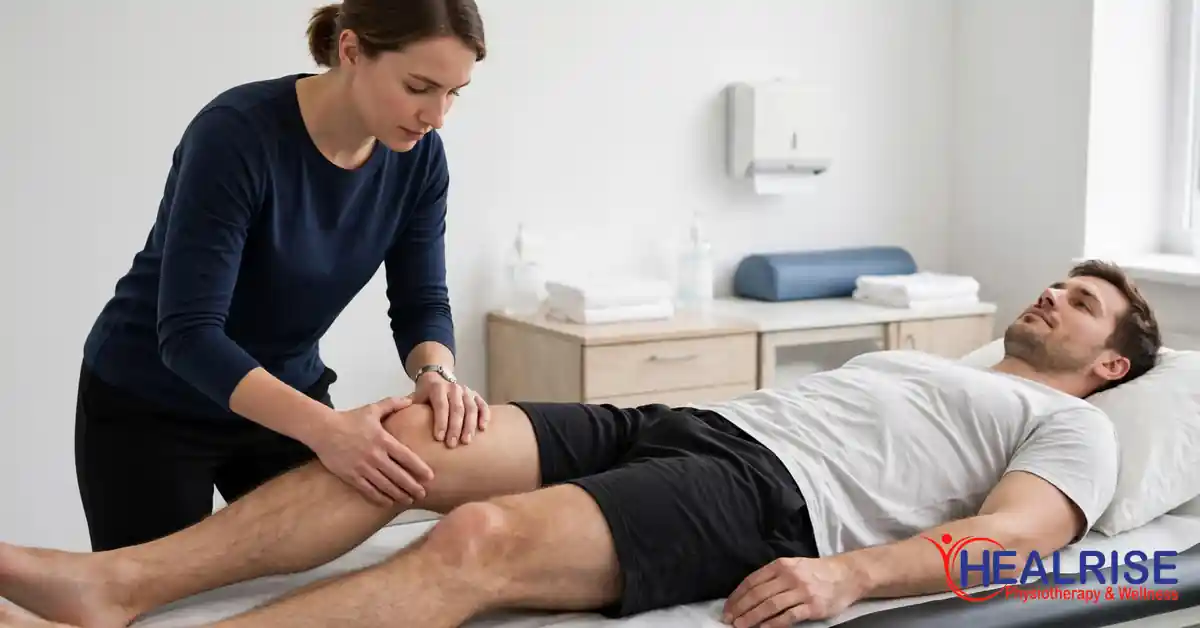
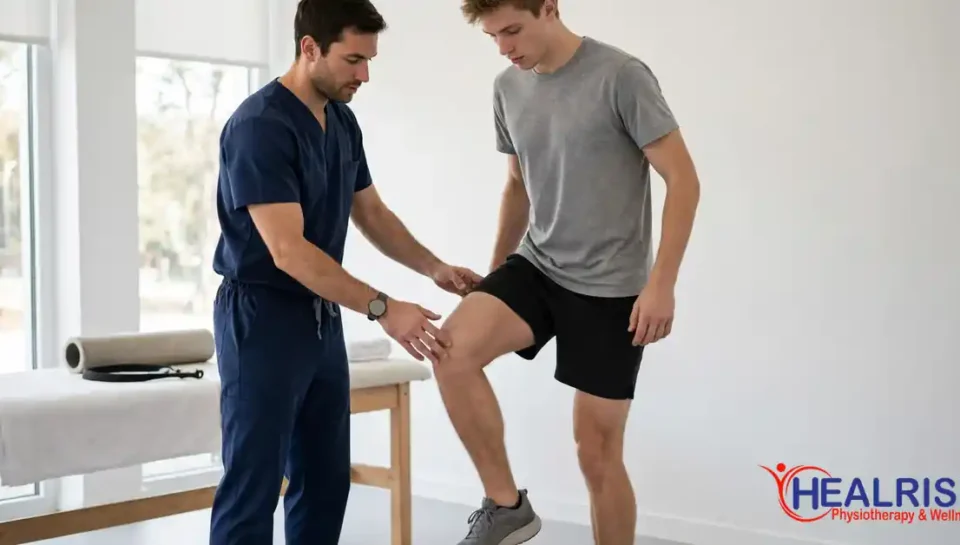
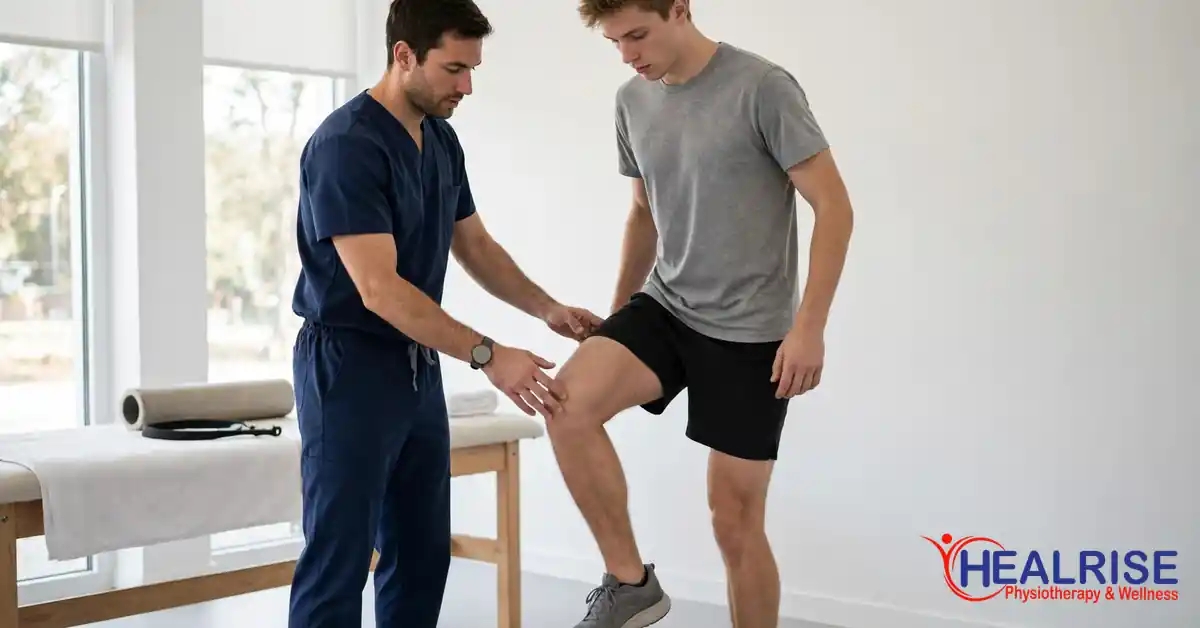
A full movement assessment. Your physiotherapist watches how you squat, step down, and balance on one leg. They test quad and hip strength, check how your kneecap moves, and look at your feet, ankles, and running shoes. They also review your training load and how quickly you built up.
Load management first. Before adding exercises, we calm the joint down. That might mean cutting running distance by half for a while, avoiding hills and deep squats, and swapping some runs for cycling or swimming. The goal is to find the amount of activity your knee tolerates today, then build from there. A helpful rule is the 24-hour rule: if pain stays at 3 out of 10 or less and settles within 24 hours, the load was about right. If it flares for more than a day, we dial back slightly, not to zero.
Quadriceps and hip strengthening. This is the heart of runner’s knee treatment Morinville programs. Quad work starts with low-irritation exercises like quad sets and straight leg raises, then progresses to wall squats, step-ups, and single-leg work. Hip work targets the gluteus medius with clamshells, band walks, and single-leg bridges. A landmark trial found that adding hip strengthening to knee exercises gave significantly better pain relief at 8 weeks than knee exercises alone. That is why we never skip the hips.
Stretching, hands-on care, and taping. Gentle stretching for tight quads, hamstrings, calves, and hip flexors reduces the sideways pull on the kneecap. Soft tissue release and joint mobilisation can ease pain while you build strength. Patellar taping, where rigid tape guides the kneecap inward, can reduce pain during activity by about 30 percent for some people. We use tape as a short-term helper, not a replacement for strengthening.
Running form and return-to-run planning. Once strength improves, we rebuild running gradually: short run-walk intervals on flat ground, then longer runs, then hills and speed work last. A slightly quicker cadence and landing with your feet under your hips can reduce kneecap load.
Most people notice real improvement within 3 to 5 weeks, with fuller recovery over 6 to 12 weeks. Chronic cases over 6 months can take 12 to 24 weeks. Runner’s knee responds to steady, progressive work, not to one heroic session.
Exercises for Runner’s Knee
The exercises below are the ones most often used in runner’s knee treatment Morinville programs. They are described so you know what to expect, not as a do-it-yourself prescription. Every knee is different, and an exercise that helps one person can flare another if the dose or form is wrong. Start any program under a physiotherapist’s guidance, keep pain at 3 out of 10 or less during exercise, and stop any movement that causes sharp pain, swelling, or giving way. Warm up first with 5 to 7 minutes of easy walking or stationary cycling.
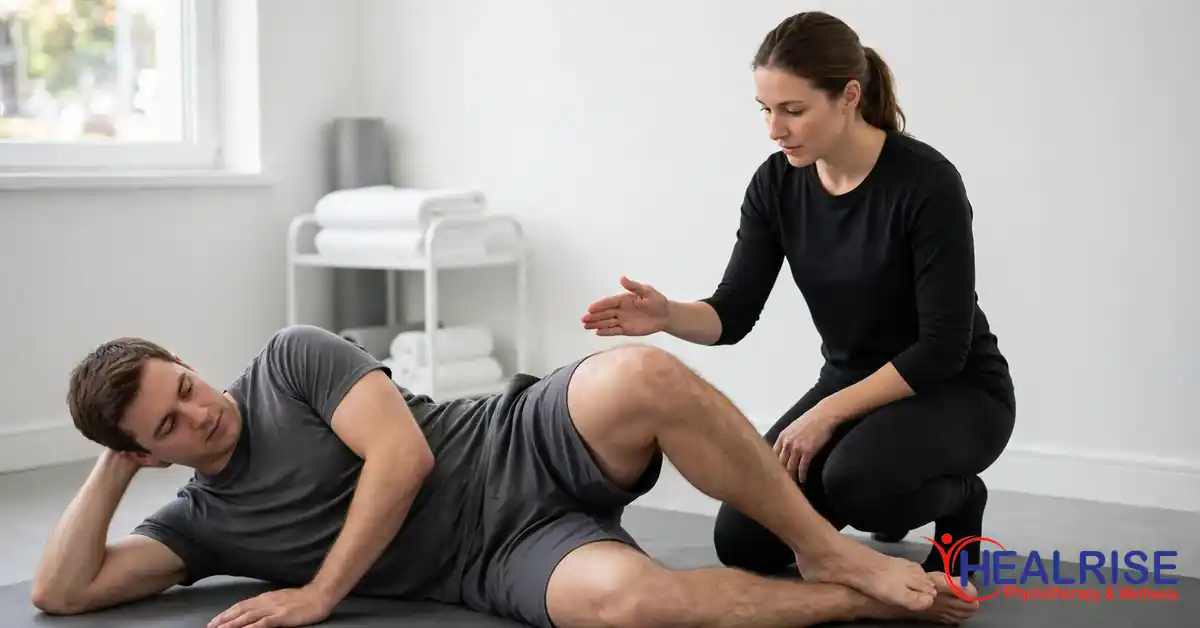
Quad sets and straight leg raises (early phase). Lie on your back, press the back of your knee gently into the bed by tightening the front of your thigh, hold 5 seconds, and repeat. For straight leg raises, keep the knee locked straight, lift the leg about 45 degrees, hold briefly, and lower slowly. These wake up the quadriceps without bending the knee under load, so they rarely irritate the kneecap.
Clamshells for the hips. Lie on your side with knees bent about 45 degrees and feet together. Keeping your feet touching, open the top knee toward the ceiling like a clamshell, hold briefly, and lower slowly. Do not roll your pelvis backward. This targets the gluteus medius, the hip muscle that stops your thigh rolling inward when you run.
Wall squats in a pain-free range. Stand with your back against a wall, feet about a foot away from the wall. Slide down only as far as you can without pain, usually well above a 90-degree bend at first, hold 5 to 10 seconds, and slide back up. Deep squats load the kneecap 7 to 8 times body weight, so depth is earned gradually, never forced.
Step-ups with slow lowering. Stand facing a low step, about 15 centimetres high. Step up with the sore leg, then lower yourself back down slowly over about 3 seconds, keeping your knee tracking over your second toe. The slow lowering phase is where the control is built. If your knee caves inward, the step is too high or the hip needs more work first.
Standing hip flexor and quad stretch. Stand tall, bend one knee and rest that foot on a stable chair behind you, gently shift your hips forward and squeeze your glutes until you feel a stretch at the front of the hip and thigh. Hold 15 to 30 seconds. Tight hip flexors and quads pull on the kneecap, so this stretch is a daily habit during rehab.
Calf stretches on a step. Stand with the balls of your feet on the edge of a step, slowly lower one heel toward the floor, hold 5 to 10 seconds, and repeat. Tight calves limit ankle movement, which changes how the knee loads when you run.
What to avoid for now. Deep squats past 90 degrees, lunges that hurt, running on hills or trails, jumping sports, and stair-stepper machines all load the kneecap heavily. They are not banned forever. They are paused until strength catches up, then reintroduced one at a time. Low-impact fitness like cycling with the seat set high enough that your knee bends less than 90 degrees, swimming, pool jogging, elliptical training, and flat walking usually keep you fit without flaring the knee. Cycling cadence around 80 to 90 revolutions per minute in an easy gear is kinder than grinding a hard gear slowly.
Consistency beats intensity. Short sessions done most days rebuild the system. One huge session once a week mostly just flares it.
What to Expect at Healrise
Your first visit at Healrise Physiotherapy and Wellness is an assessment, usually about an hour. Your physiotherapist will ask when the pain started, what makes it better or worse, how much you train, and what your goal is. Bring your running shoes and any training log you keep.
Then comes the physical assessment: quad and hip strength, single-leg squat and step-down quality, kneecap movement, and ankle flexibility. You will leave with a clear explanation and a staged plan: calm the joint, build strength, then return to running step by step.
You do not need a referral to book. Most extended health benefit plans in Alberta cover physiotherapy, and direct billing is available for many plans. Healrise Physiotherapy and Wellness is at Unit 101, 10507 100 Ave, Morinville, Alberta, T8R 1A2. Call 587-485-0787 or book online through healrisephysiotherapy.ca.
Runner’s knee treatment Morinville care at Healrise is honest about timelines. We cannot promise a pain-free marathon in two weeks. We can promise a proper assessment, a progressive program, and clear checkpoints: stairs with less pain, a longer run before the ache starts, better single-leg control.
Runner’s Knee or Surgery?
Surgery is very rarely the answer for runner’s knee. Over 90 percent of cases resolve with exercise, load management, and taping. Surgery is reserved for the small number of people who have done 6 to 12 months of proper rehab without improvement and have specific anatomical findings on imaging. Even then, physiotherapy is still needed afterward.
If surgery is mentioned before you have tried a structured strengthening program, it is reasonable to ask what conservative care has been tried first. For most people, a well-run runner’s knee treatment Morinville program is both the first and the final treatment they need.
When to See a Doctor Urgently
Most runner’s knee is not dangerous and can be managed over weeks. But some knee symptoms need urgent medical care. Go to urgent care or the hospital, or call your doctor the same day, if you notice:
A knee that locks or cannot straighten. A knee stuck in one position can mean a torn meniscus fragment blocking the joint.
Rapid swelling after an injury. A knee that blows up within hours of a twist or fall can mean bleeding inside the joint from a ligament or cartilage injury.
The knee gives way or feels unstable. Repeated buckling suggests ligament damage, not simple patellofemoral pain.
You cannot put weight on the leg. Inability to bear weight after an injury needs prompt assessment and possibly an X-ray.
Fever, redness, or severe pain at rest. A hot, red, very painful knee with fever can indicate infection inside the joint. This is an emergency.
Pain after a fall or direct blow. A hard fall onto the kneecap, or pain that is getting rapidly worse, needs medical review.
Also book a runner’s knee treatment Morinville assessment soon if pain has lasted more than 2 to 3 weeks, keeps coming back every time you run, or is stopping you from work, school, or daily activities. The earlier the load and strength issues are addressed, the shorter the recovery.
Preventing Runner’s Knee From Coming Back
Once the pain settles, the goal is to keep it settled. These habits are worth keeping year-round, especially through Alberta winters when outdoor running drops and gym work spikes in January.
Build load gradually. Increase running distance, hill work, or squat volume by about 10 percent per week at most.
Keep hips and quads strong. Two short strength sessions a week maintain the muscle support your kneecap needs.
Replace worn shoes and vary surfaces. Running shoes lose cushioning after roughly 500 to 800 kilometres. Save hills for when your knee is fully settled.
Mind sitting time. Stand up and straighten your legs every 30 to 45 minutes during long desk or driving days.
Warm up and cool down. Five to seven minutes of easy walking or cycling before hard sessions prepares the joint for load.
Runner’s knee treatment Morinville programs at Healrise finish with a prevention plan, because getting you pain-free is only half the job. Keeping you running is the other half.
Frequently Asked Questions
How long does runner’s knee take to heal?
Mild cases with a clear trigger, like a sudden jump in running distance, often settle in 4 to 8 weeks of structured rehab. Cases present for more than 6 months, or with significant hip weakness, typically need 12 to 24 weeks of progressive work. Studies show 73 to 80 percent of people achieve full resolution with consistent exercise-based rehab. Pushing load too fast is the most common reason recovery stalls.
Should I stop running completely with runner’s knee?
Not necessarily. Complete rest is rarely the best approach, because the muscles that protect the kneecap weaken further. The goal is to find a running dose your knee tolerates: pain at 3 out of 10 or less during the run and settled within 24 hours. For many people that means cutting distance by 50 to 70 percent for a while, avoiding hills and speed work, and using run-walk intervals. Some irritable knees need a 2 to 4 week running break first. Your physiotherapist will set your starting dose and progress it week by week.
Is cycling safe with runner’s knee?
Usually yes, and it is one of the best ways to keep fitness while the knee settles. Cycling loads the kneecap less than running or stairs. Set the seat high so your knee bends less than 90 degrees at the top of the pedal stroke, pedal at a comfortable cadence around 80 to 90 revolutions per minute in an easy gear, and start with 15 to 20 minutes. Check the 24-hour response before adding time. Stationary cycling is ideal early on because there are no hills or stops to manage.
Do I need a referral to book physiotherapy in Morinville?
No. You can book directly with Healrise Physiotherapy and Wellness without a doctor’s referral. If you have imaging reports or a referral letter, bring them along, as they help your physiotherapist plan your assessment, but they are not required. Some insurance plans ask for a referral for reimbursement, so check your plan details.
Is runner’s knee physiotherapy covered by insurance in Alberta?
Most extended health benefit plans in Alberta cover physiotherapy, typically with an annual limit, and direct billing is available for many plans. If your knee pain came from a work injury, WCB Alberta may cover treatment. If it followed a motor vehicle accident, accident benefits may apply. Ask our front desk and we will confirm your coverage before you start.
Disclaimer
This article is for general information only and is not medical advice. Every knee is different, and the right treatment depends on your own assessment. If you have severe pain, locking, instability, rapid swelling, or fever with a hot knee, seek urgent medical care. Always speak with a physiotherapist or your doctor before starting any exercise program.
Book Your Assessment
If the front of your knee aches every time you run, climb stairs, or sit too long, a proper assessment is the first step. Runner’s knee treatment Morinville runners and active people trust is available at Healrise Physiotherapy and Wellness. We will assess your knee, hips, and movement, explain what is going on in plain words, and build a staged plan to get you back to the activities you love. No referral needed. Call 587-485-0787 or book online through healrisephysiotherapy.ca. Healrise Physiotherapy and Wellness is at Unit 101, 10507 100 Ave, Morinville, Alberta, T8R 1A2. Book an assessment today and take the first step toward running without front knee pain.