by
Intro
You bend down to pick up a laundry basket, and a sharp pain shoots through one side of your low back. Or you have been sitting for an hour, and when you stand up, your buttock aches and your leg feels stiff. Or you roll over in bed at night, and the pain wakes you up. You have tried stretching your back, but it does not help, and the pain keeps coming back in the same spot.
That pain may not be coming from your back at all. It may be coming from your sacroiliac joint, the joint where your spine meets your pelvis. It is a small joint, but it carries a big job, and when it is not working properly, it can cause months of pain. Research suggests that between 15 and 40 out of every 100 cases of low back pain are really caused by a sacroiliac joint problem. This guide explains it in plain language: what the joint is, how its pain differs from sciatica and hip pain, what causes it, and the treatment and exercises that help.
Table of Contents
What Is the Sacroiliac Joint?
The sacroiliac joint, usually shortened to the SI joint, is where the sacrum meets the pelvis. The sacrum is the triangular bone at the base of your spine, just above your tailbone. The pelvis is the ring of bone that connects your spine to your legs. You have two SI joints, one on each side, low in your back, just above the buttocks.
The SI joint is not like your knee or your shoulder. It barely moves. It is designed to be strong and stable, not flexible. Its job is to transfer weight between your upper body and your legs. Every time you walk, climb stairs, or lift something, the force passes through the SI joints. Strong ligaments hold it together, and the glutes, deep core, and pelvic floor keep it steady.
Because the joint moves so little, it is easy to forget it exists. But when it stops working properly, it hurts. The joint can become too stiff, or it can become too loose and move too much. Both problems cause pain, and both are treated with physiotherapy, but the treatment is different for each one. That is why a proper assessment matters more than a generic set of back exercises.
SI Joint Pain vs Sciatica vs Hip Pain: How to Tell Them Apart
SI joint pain, sciatica, and hip pain all cause pain in roughly the same area, and they are often confused. But they are different problems with different treatment, so getting the diagnosis right matters.
SI joint pain is usually felt low on one side of the back, just above the buttock, or deep in the buttock itself. It can spread into the groin or the back of the thigh, but it rarely goes below the knee. It is often worse when you stand on one leg, climb stairs, get out of a car, or roll over in bed. The pain is often a dull ache with occasional sharp twinges, and the area can feel stiff in the morning. If your low back pain has this one-sided pattern, our guide to back pain physiotherapy in Morinville explains how back problems are assessed and treated.
Sciatica is pain that follows the sciatic nerve down the leg. It usually starts in the buttock and travels down the back of the thigh, often past the knee and sometimes to the foot. It can come with tingling, numbness, or weakness in the leg. The pain is often sharp or burning, and coughing or sneezing can make it worse. It is usually caused by a disc or a tight muscle pressing on the nerve, not by the SI joint. Our guide to sciatica physiotherapy in Morinville explains the difference in more detail.
Hip pain is usually felt in the groin or on the outside of the hip, and it is often worse with walking, squatting, or lying on the sore side. Hip arthritis causes a deep, aching pain in the groin that gets worse with activity. The key difference is that hip pain is felt in the front or the side of the hip, while SI joint pain is felt in the back. Our guide to hip pain physiotherapy in Morinville covers the common hip problems.
Here is a simple check you can do at home, although it does not replace a proper assessment. Stand on one leg, the sore side, and lift the other foot off the ground. If that makes the pain worse on the side you are standing on, that points toward the SI joint. If the pain shoots down your leg past the knee, that points more toward sciatica. If the pain is in the groin, that points more toward the hip.
What Causes Sacroiliac Joint Pain?
SI joint pain does not usually come from one single event. It builds up when the joint is loaded in a way it is not ready for, or when the muscles that support it become weak. The most common causes are:
Pregnancy and childbirth. This is the most common cause in women. During pregnancy, the body releases a hormone called relaxin, which loosens the ligaments around the pelvis so the baby can pass through. That looseness is necessary, but it also makes the SI joints less stable. Add the extra weight of the baby and the changed posture, and the SI joints take a heavy load. Many women first notice SI joint pain during pregnancy or in the months after birth.
A fall or a sudden twist. Falling onto your buttocks, slipping on ice, or twisting suddenly while lifting something heavy can sprain the ligaments around the SI joint. The pain often starts right after the event and does not settle the way a simple muscle strain would.
Uneven legs or an old injury. If one leg is slightly shorter than the other, or if you had a hip or knee injury that changed the way you walk, the SI joints take uneven load, day after day. Over months and years, that uneven load wears the joint down.
Long sitting and poor posture. Sitting for hours, especially in a soft chair or with one leg crossed over the other, loads one SI joint more than the other. People who drive for a living or sit at a desk all day often develop SI joint pain slowly, without any single injury.
Arthritis. The SI joint can develop arthritis, just like any other joint. Inflammatory arthritis often starts in the SI joints and causes pain that is worse in the morning and better with movement. Osteoarthritis can also affect the joint in older adults.
Symptoms of Sacroiliac Joint Pain
SI joint pain usually starts gradually, although it can also start suddenly after a fall or a twist:
Pain low on one side. The pain is usually on one side only, low in the back, just above the buttock, or deep in the buttock. It is uncommon for it to be felt equally on both sides, although it can happen, especially after pregnancy.
Pain that spreads, but not far. The pain can spread into the groin, the front of the thigh, or the back of the thigh. It rarely goes below the knee. If your pain goes all the way to your foot, or you have numbness and tingling in the leg, that is more likely sciatica than SI joint pain.
Worse with one-legged activities. Standing on one leg, climbing stairs, getting out of a car, and walking up a hill all load the SI joint on one side. Getting in and out of bed, and rolling over in bed, are also common triggers.
Stiffness in the morning. The joint often feels stiff when you first get up, and it loosens up as you move around.
How Physiotherapy Diagnoses SI Joint Pain
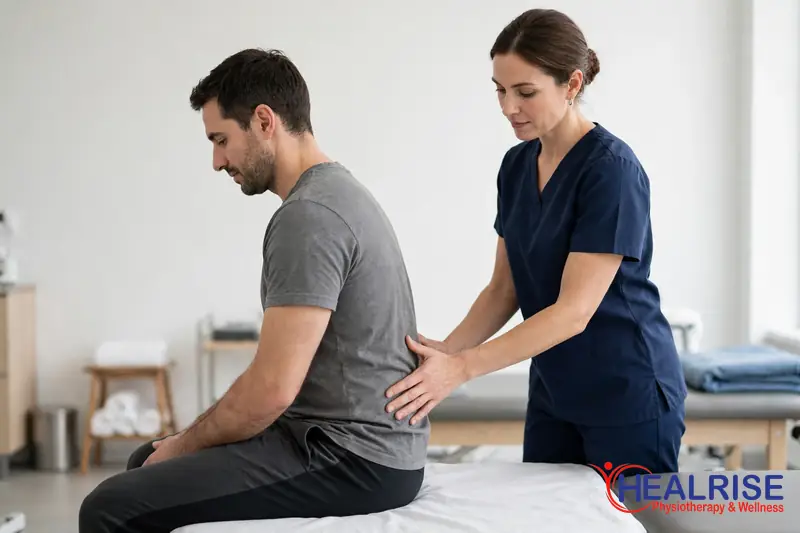
An SI joint assessment at Healrise is straightforward and usually takes one visit. You do not need a doctor’s referral, and you do not need a scan to start treatment.
Your physiotherapist will start by asking about your pain: where it is, when it started, what makes it worse, and what you do for work and fun. They will ask about pregnancy, falls, previous injuries, and surgery, because all of these change how the joint behaves.
Then comes the hands-on examination. Your physiotherapist will test how your SI joints, hips, and low back move, and whether one leg is longer than the other. They will do a series of gentle tests that stress the SI joint in different ways. No single test proves the diagnosis, but if three or more of these tests reproduce your pain, that is a strong sign the SI joint is the problem.
Your physiotherapist will also check the muscles around the joint: the glutes, the deep core muscles, and the pelvic floor. Weakness in these muscles is one of the most common reasons the SI joint becomes painful. Our guide to pelvic floor physiotherapy in Morinville explains how the pelvic floor supports the pelvis and the SI joints.
An X-ray or MRI is not usually needed. The SI joint often looks normal on a scan even when it is painful. Imaging is only needed if your physiotherapist suspects something else, such as inflammatory arthritis, a fracture, or an infection, or if the pain does not improve with treatment.
Sacroiliac Joint Pain Treatment: What Works
SI joint pain responds well to physiotherapy, but the treatment has to match the problem. A stiff joint needs different treatment from a loose joint.
Manual therapy. Hands-on treatment is often the fastest way to ease SI joint pain. If the joint is stiff, your physiotherapist uses gentle mobilization to restore its movement. If the muscles around it are tight, soft tissue treatment helps them relax, so you can start moving and exercising properly.
Stabilization exercises. This is the core of the treatment, and it is what keeps the pain from coming back. The glutes, the deep core muscles, and the pelvic floor work together to hold the SI joint steady. When they are weak, the joint moves too much and hurts. When they are strong, the joint is supported and the pain settles. The exercises start gently and build up over weeks.
An SI belt. A sacroiliac belt is a wide, firm belt worn low around the pelvis. It squeezes the SI joints gently and gives them extra stability. It can be very helpful in the first few weeks, especially after pregnancy or a fall, because it reduces the pain and lets you move more comfortably. It is a support, not a cure, and it should not be worn all day, every day.
Dry needling and acupuncture. If the muscles around the SI joint are very tight and sore, dry needling or acupuncture can help them relax. Fine needles are placed into the tight spots in the glutes and low back, which reduces the spasm and the pain. This is used alongside exercise, not instead of it.
Activity modification and graded return. Small changes make a big difference: avoid sitting with your legs crossed, get up and move every 30 minutes, sleep with a pillow between your knees, and lift with your legs instead of twisting. Once the pain has settled and the muscles are stronger, return to your normal activities gradually, not all at once, so the joint is not overloaded again.
7 Exercises That Help SI Joint Pain
These exercises are safe to start at home, but they are not a substitute for an assessment. If you are unsure about the diagnosis, or you have numbness, tingling, or weakness in your leg, see a physiotherapist first.

1. Diaphragmatic Breathing
Lie on your back, knees bent, one hand on your chest and one on your belly. Breathe in slowly through your nose so your belly rises and your ribs widen. Breathe out slowly through your mouth. Ten breaths, twice a day. This is the foundation of SI joint stability: the diaphragm works with the deep core and the pelvic floor to create pressure that supports the pelvis.
2. Pelvic Tilts
Lie on your back, knees bent, feet flat. Gently flatten your low back into the floor by tightening your lower abdominal muscles, then relax. Hold for five seconds, then release. Do ten repetitions, twice a day. This wakes up the deep core muscles that stabilize the joint.
3. Glute Bridges
Lie on your back, knees bent, feet flat on the floor, hip-width apart. Squeeze your buttocks and lift your hips a few centimetres off the floor, hold for five seconds, then lower slowly. Do three sets of ten, once a day. The glutes are the most important muscles for SI joint stability. When they are weak, the SI joint takes too much load.
4. Clamshells
Lie on your side, knees bent, feet together. Keeping your feet together, lift the top knee like opening a clamshell, then lower it slowly. Do three sets of ten on each side, once a day. This strengthens the gluteus medius, the hip muscle that keeps your pelvis level when you walk.
5. Bird-Dog
Start on your hands and knees, back flat, core gently engaged. Slowly reach one arm forward and the opposite leg back, keeping your hips level. Hold for five seconds, then return. Do three sets of eight on each side, once a day. This trains the core and glutes to hold the pelvis steady.
6. Dead Bug
Lie on your back, arms pointing up, knees bent at 90 degrees. Slowly lower one arm and the opposite leg toward the floor, keeping your low back flat. Return and repeat on the other side. Do three sets of eight on each side, once a day. This builds deep core strength without loading the joint.
7. Standing Hip Hinge
Stand with your feet hip-width apart, knees slightly bent. Push your hips back as if you are closing a car door with your bottom, keeping your back straight and your chest up. Return to standing by squeezing your glutes. Do three sets of ten, once a day. This teaches you to bend and lift with your hips and legs, not your low back.
What to Avoid With SI Joint Pain
Some movements make SI joint pain worse. Avoiding them matters as much as doing the right exercises.
Sitting with your legs crossed. This twists the pelvis and loads one SI joint more than the other. Sit with both feet flat on the floor.
Heavy lifting with a twist. Lifting a heavy box and turning at the same time is one of the most common ways to irritate the SI joint. Turn your whole body and keep the load close.
Deep squats and heavy deadlifts. These load the SI joint heavily and are not safe until the joint is stable and the muscles are strong.
Sleeping on your stomach. This twists the pelvis and the low back. Sleep on your side with a pillow between your knees.
High-impact exercise. Running, jumping, and intense classes are too much load for a painful SI joint. Walk, swim, or cycle gently until the pain has settled and your physiotherapist clears you for more.
SI Joint Pain in Pregnancy and After Birth
SI joint pain is one of the most common complaints in pregnancy, and it is also common in the months after birth. During pregnancy, the hormone relaxin loosens the ligaments around the pelvis. That is necessary for birth, but it makes the SI joints less stable. The extra weight of the baby and the changed posture add load to the joints. Many women first notice the pain in the second or third trimester, when they stand on one leg to get dressed, climb stairs, or roll over in bed.
After birth, the ligaments tighten up again, but the muscles are weak and the pelvis is still recovering. SI joint pain after birth is common, and it often goes together with pelvic floor weakness and back pain. The good news is that it is very treatable: the stabilization exercises in this guide, plus pelvic floor work, help most women recover within a few months. If you have recently had a baby and your SI joints are sore, our guide to postpartum physiotherapy in Morinville explains the full recovery picture.
When to See a Physiotherapist in Morinville
Book an assessment if any of these sound familiar:
- Your low back or buttock pain is mainly on one side, and it has been there for more than two weeks
- The pain is worse when you stand on one leg, climb stairs, or get out of a car
- You have pain when you roll over in bed, or when you sit for a long time
- You had SI joint pain during pregnancy, and it has not settled after birth
- You have tried stretching and painkillers, and the problem is still there
- You want to return to running, lifting, or sport, and you are not sure your pelvis is ready
Seek medical attention sooner if you have pain after a serious fall or car accident, a fever, unexplained weight loss, numbness or weakness in the legs, or bladder or bowel changes. These are uncommon, but they need prompt checking. You do not need a doctor’s referral to see a physiotherapist in Alberta, and most extended health plans cover physiotherapy without a referral.
At your first appointment, the physiotherapist will ask about your pain, test your SI joints, hips, and back, and check the strength of your glutes, core, and pelvic floor. Most people need four to eight sessions over six to eight weeks, with home exercises in between.

Frequently Asked Questions
Is SI joint pain the same as sciatica?
No, although they are often confused. SI joint pain is usually felt low on one side of the back or deep in the buttock, and it rarely goes below the knee. Sciatica is pain that travels down the leg, often past the knee and sometimes to the foot, and it can come with tingling, numbness, or weakness. SI joint pain is a joint problem. Sciatica is a nerve problem. An assessment will sort out which one you have.
How long does SI joint pain take to heal?
It depends on the cause. If the pain started after a fall or a sudden twist, it often improves within four to six weeks of treatment. If it has been there for months, or it started during pregnancy, it usually takes eight to twelve weeks to fully resolve. The joint itself heals faster than the muscles around it. People who do their exercises regularly recover fastest.
Can I exercise with SI joint pain?
Yes, and you should, but with the right exercises. Gentle stabilization exercises, including the 7 exercises in this guide, are safe and helpful. Walking is also good, as long as it does not make the pain worse. Avoid heavy lifting, deep squats, and running. Your physiotherapist will tell you which exercises are safe for you and when you can progress to harder ones.
Will an SI belt fix my SI joint pain?
An SI belt helps, but it does not fix the problem on its own. It gives the joints extra stability and reduces the pain, which makes it easier to move and exercise. But the long-term fix is stronger muscles, especially the glutes and the deep core, holding the joint steady. Think of the belt as training wheels: useful while you build strength, but not something you should need forever.
Does SI joint pain come back?
It can, especially if the muscles get weak again or if you go back to the activity that caused it. The best way to prevent it coming back is to keep doing the stabilization exercises a few times a week, even after the pain has gone, and to keep the habits that protect the joint: getting up regularly, lifting with your legs, and sleeping with a pillow between your knees. Most people who keep up their exercises stay pain-free.
Conclusion
SI joint pain is frustrating, because it is often blamed on the back, and back stretches do not fix it. But it is also very treatable. The people who recover best get assessed early and follow a plan that calms the joint down, then rebuilds the muscles that hold it steady. If your low back or buttock pain is mainly on one side, or if it has been there for weeks and stretching is not helping, do not guess. For sacroiliac joint pain physiotherapy in Morinville, book an assessment at Healrise Physiotherapy.
Healrise Physiotherapy and Wellness
10507 100 Ave, Unit 101, Morinville, AB T8R 1A2
Phone: +1 587-485-0787