by
You are walking to the kitchen to make tea, and your foot catches on the edge of a rug. You grab the counter just in time. Or you step outside on a cold Morinville morning, and the sidewalk looks clear, but there is a thin sheet of ice under a dusting of snow. Your feet slide, and for one frightening second you are not sure you will stay upright.
If any of this sounds familiar, you are not alone. About one in three adults over 65 falls at least once a year, and after 80 it is about one in two. Most falls cause no serious injury. But even a fall that leaves no bruise can leave a fear of falling again, and that fear makes people move less, which weakens the legs and makes the next fall more likely.
The good news is that most falls can be prevented. Falls are not a normal part of getting older. Research shows that physiotherapy, especially balance and strength training, can cut the risk of falling by a large amount. This guide to falls prevention for seniors in Morinville explains why falls happen, the seven exercises that make the biggest difference, how to make your home safer, and how to walk safely on Morinville ice.
Table of Contents
Why Falls Happen More Often After 65
Falls rarely have a single cause. They usually happen when several small changes add up. Balance gets weaker with age, because the body keeps its balance using three systems: the eyes, the inner ear, and the feeling in the feet and legs. With age, all three become less sharp. Eyesight gets worse, the inner ear becomes less sensitive, and the nerves in the feet send weaker signals to the brain. When one system weakens, the others can compensate. When two or three weaken at once, balance becomes fragile.
Muscles get weaker too, especially in the legs. After 60, most people lose strength gradually, and the loss speeds up if they are not active. Weak ankles cannot correct a stumble quickly enough. Weak hips cannot steady the body when stepping sideways. Weak thighs make it hard to rise from a chair without using the arms, and that first unsteady moment on standing is when many falls happen. Reaction time also slows down, so a correction that once came in a fraction of a second now takes longer, and sometimes it does not come in time. Add loose rugs, clutter, poor lighting, stairs without a handrail, and shoes with worn soles, and any one of them can be the last straw. None of these changes is fixed or final. Balance can be trained at any age, strength can be rebuilt at any age, and the home can be changed in an afternoon. Our guide to physiotherapy for seniors in Morinville explains how physiotherapy helps older adults stay active and independent.
The Real Cost of a Fall: More Than a Bruise
Most falls cause only a bruise or a scare. But about one in five falls causes a serious injury, and the consequences can change a person’s life. A broken hip is the most feared result. It usually needs surgery, then weeks in hospital, then months of rehabilitation. About half of the people who break a hip never fully get back to the way they were before. A broken wrist is more common and less serious, but it still means weeks in a cast. The risk of a fracture is higher when the bones are thin. If you have osteoporosis, a fall that would only bruise a person with strong bones can break a bone in yours. Our guide to osteoporosis physiotherapy in Morinville explains how safe exercise builds bone strength and reduces fracture risk.
But the cost of a fall is not only physical. Many people who fall once become afraid of falling again, and that fear changes how they live. They stop going for walks, stop visiting friends, avoid stairs, and avoid going out in winter. Within months, their world gets smaller, their legs get weaker from disuse, and their risk of falling goes up, not down. Doctors call this the fear-of-falling cycle. Fear also changes how you walk: steps get shorter and slower, the body holds stiffly, and the eyes fix on the ground instead of ahead. Break the cycle with small, safe steps. Practise balance exercises with support close by, walk with a friend, and set small goals, like walking to the end of the driveway, then to the end of the street. Each small success rebuilds confidence.
How Physiotherapy Prevents Falls
Physiotherapy prevents falls in a way that no pill and no gadget can. It works on the body itself, rebuilding the balance, strength, and reaction speed that keep you upright. The first thing a physiotherapist does is find out why you are at risk. Two people can fall for completely different reasons. One person may have weak ankles. Another may have dizziness from an inner ear problem. A third may have stiff hips that make turning difficult. The treatment is different for each one, so a proper assessment matters more than a generic set of exercises.
Once the cause is clear, the physiotherapist builds a program around it. The core of every falls prevention program is balance training and leg strengthening. Balance training teaches the body to correct itself faster when it is disturbed. Strength training rebuilds the muscles in the ankles, hips, and thighs that keep you upright. Together, they are the most effective falls prevention treatment that exists. Studies show that balance and strength programs can reduce falls by about a third, and by even more in people who practise regularly. Physiotherapy also works on the things that make balance harder. Stiff ankles are stretched, tight hip muscles are loosened, and a shuffling walk, where the feet barely lift off the ground, is retrained until it is smooth and confident again. A shuffling walk is itself a fall risk, because the toes catch on small obstacles. Physiotherapy also helps with the fear of falling, by giving you a safe place to practise with support close by, so confidence can be rebuilt gradually.
Your First Visit: The Fall-Risk Assessment
If you are worried about falling, or if you have already fallen once, the best first step is a fall-risk assessment at a physiotherapy clinic. It takes about an hour, it is painless, and it tells you exactly where your risks are. The physiotherapist will start by asking questions: have you fallen in the past year, do you feel unsteady, do you get dizzy on standing, what medicines do you take, and do you use a cane or walker?
Then comes the physical testing. The most common tests are simple and well proven. The Timed Up and Go test measures how long it takes you to stand up from a chair, walk three metres, turn around, walk back, and sit down again. Taking longer than about 12 seconds suggests a higher fall risk. The Berg Balance Scale tests 14 everyday balance tasks. The 30-second chair stand test counts how many times you can stand up in 30 seconds, which measures leg strength. The physiotherapist will also watch you walk, check the strength of your ankles, hips, and knees, and test your flexibility. If dizziness is part of the problem, they may test the inner ear. Dizziness and vertigo are common and treatable causes of falls, and our guide to vestibular physiotherapy in Morinville explains how the inner ear affects balance and what can be done about it. At the end, you will get a clear answer: what your main risks are, and what to do about them. Bring a list of your medicines and the shoes you normally wear, and if you use a cane or walker, bring that too.
7 Balance and Strength Exercises to Do at Home
These seven exercises target the ankles, hips, and thighs, and they train the balance systems. Do them two or three times a week, where you can hold onto something sturdy, like a kitchen counter or the back of a heavy chair. Wear flat, closed-toe shoes, and stop if you feel pain.

1. Heel-to-Toe Walking
Stand beside a counter so you can touch it for support. Place one foot directly in front of the other, heel touching toe, like walking along a straight line. Take 10 slow steps forward, then turn carefully and walk 10 steps back. Keep your eyes forward, not down at your feet. This trains balance when your base of support is narrow.
2. Single-Leg Standing
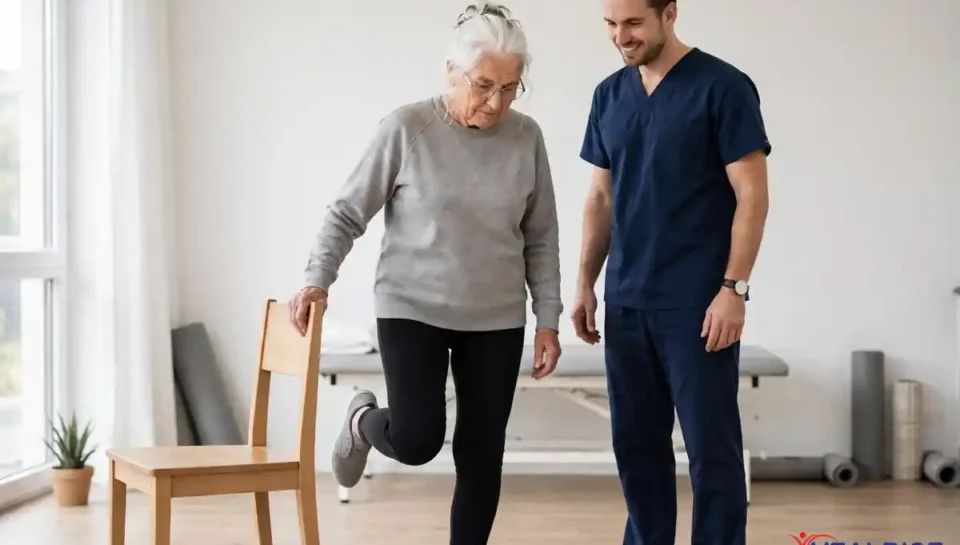
Stand behind a sturdy chair and hold the back lightly with both hands. Lift one foot off the ground, just a few centimetres, and balance on the other leg for 10 seconds. Put the foot down, rest, and repeat on the other side. Do this five times on each leg. As you get stronger, hold on with one hand, then no hands. This trains the ankle muscles that catch you when you stumble.
3. Sit-to-Stand
Sit on a firm chair with your feet flat on the floor, hip-width apart. Cross your arms over your chest, lean forward slightly, and stand up without using your hands. Sit back down slowly, in control, without dropping into the chair. Repeat 10 times. This builds the thigh and hip strength you need to rise from a chair without wobbling.
4. Side Leg Raises
Stand behind a chair, holding the back with both hands. Keeping your back straight and your toes pointing forward, lift one leg out to the side about 30 centimetres, then lower it slowly. Do not lean to the other side. Repeat 10 times on each leg. This strengthens the hip muscles that keep your pelvis level when you walk and stop you from swaying sideways.
5. Heel Raises
Stand behind a chair, holding the back lightly. Rise up onto your toes, lifting both heels off the ground, hold for two seconds, then lower slowly. Repeat 15 times. This strengthens the calf muscles and the ankles, which are the first line of defence when you trip.
6. Tandem Stance with Head Turns
Stand with one foot directly in front of the other, heel to toe, holding a counter lightly. Slowly turn your head to the left, then to the right, then look up, then look down. Do this for 30 seconds, then swap feet and repeat. Turning the head while balancing trains the inner ear and the eyes to work together, which is what you need when you look around while walking. If you have knee pain that limits how you walk, our guide to knee pain physiotherapy in Morinville explains how knee problems affect balance and what helps.
7. Marching on the Spot
Stand behind a chair, holding the back lightly. March on the spot, lifting each knee to about hip height, for 30 seconds. Keep your back straight and your steps even. This builds leg strength and coordination, and it trains the body to lift the feet properly instead of shuffling. Shuffling is a major fall risk, because the toes catch on carpets, thresholds, and cracks in the pavement.
A note of caution: if you have a medical condition that affects your balance, or if you have fallen and been injured, talk to a physiotherapist before starting.
Walking Safely on Ice: Morinville Winter Tips
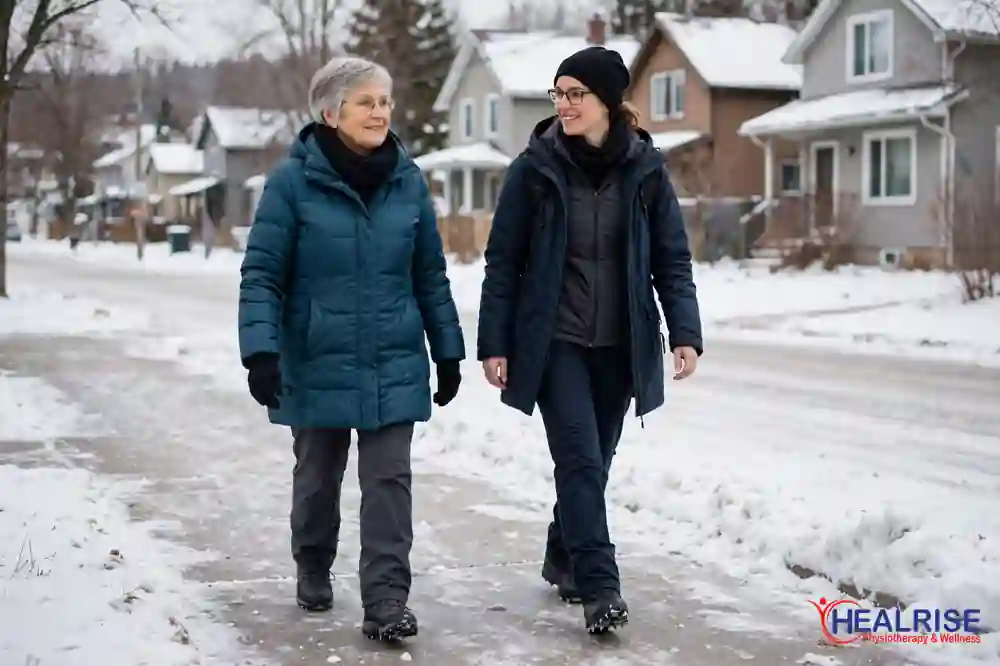
Morinville winters are beautiful and long, and they are also the most dangerous time of year for falls. Ice is the main problem, and it is often invisible. A sidewalk can look clear and still be covered in a thin layer of black ice. Walk like a penguin: take short, flat steps, keep your feet slightly apart, keep your weight over your feet, point your toes slightly outward, and keep your knees a little bent.
Wear the right footwear. Winter boots with a deep tread grip ice far better than smooth-soled shoes or dress shoes. Ice grips, also called ice cleats, are rubber or metal attachments that fit over your shoes. They cost little, they are sold at most hardware stores in the Morinville and St. Albert area, and they make a real difference on icy sidewalks. Put them on before you go outside, and take them off indoors.
Use your hands for balance, not for carrying. Carry shopping in a backpack or a bag with a shoulder strap, so both hands are free. If you must carry something in your hands, carry it in one hand only and keep the other free to grab a railing or steady yourself. Never walk on ice with your hands in your pockets. Use the railing on every set of stairs. If a sidewalk looks icy, walk on the grass or the snow beside it, where there is more grip. If you are not sure about a surface, ask someone to walk with you. Keep your walkway clear of snow and ice, and spread sand or salt. If the weather is very bad, stay indoors if you can. No errand is worth a broken hip.
Making Your Home Safer: Room-by-Room Checklist
Most falls happen at home, and most home falls can be prevented with simple changes. In the living room and hallways, remove loose rugs or tape them down with double-sided tape. Move cords, cables, and clutter off the floor. Make sure the path from your bed to the bathroom is clear, because many falls happen on the way to the bathroom at night. Add a night light in the hallway and the bathroom so you can see where you are going without turning on a bright light.
In the bathroom, install grab bars beside the toilet and inside the shower or bath. A grab bar is far stronger and safer than a towel rail, which can pull out of the wall. Use a non-slip mat in the shower and a bath seat if standing in the shower feels unsteady. In the kitchen, keep everyday items on shelves between waist and shoulder height, so you do not have to climb onto a chair or bend down low. Clean up spills immediately, and never stand on a chair to reach a high shelf.
On the stairs, make sure there is a handrail on at least one side, and use it every time. Mark the edge of each step with a strip of contrasting tape if the steps are hard to see. Keep the stairs clear of shoes, books, and laundry, and make sure the lighting is good at the top and bottom. Throughout the home, improve the lighting. Older eyes need more light, so add brighter bulbs in hallways and stairways, and use motion-sensor night lights.
Medicines, Vision and Hearing: The Hidden Fall Risks
Some fall risks are not in the muscles or the home. They are in the medicine cabinet, the eyes, and the ears. Many common medicines increase the risk of falling. Sleeping pills and anxiety medicines can cause drowsiness and slow reactions. Some blood pressure medicines can cause a sudden drop in blood pressure when you stand up, which makes you dizzy. Some painkillers, antidepressants, and diabetes medicines can also affect balance. Taking four or more medicines at once, which is common in older adults, increases the risk further. If you take several medicines, ask your doctor or pharmacist to review them. Do not stop taking any medicine on your own, but do ask whether the dose can be adjusted or a safer alternative exists.
Vision matters more than most people realise. Poor eyesight makes it hard to see obstacles, judge distances, and notice changes in the floor. Bifocal and progressive glasses can make stairs and curbs hard to judge, because the lower part of the lens is made for reading. If you wear bifocals, take extra care on stairs. Have your eyes checked every year and keep the prescription up to date. Hearing also plays a part. The inner ear contains the balance organs, and hearing loss often goes together with balance problems. If you have a hearing aid, wear it. If you have dizziness or a feeling that the room is moving, tell your doctor or physiotherapist. Dizziness has many causes, and several are treatable.
Footwear and Walking Aids: What Actually Helps
The right shoes and the right walking aid can prevent falls. The wrong ones can cause them. Good shoes for falls prevention are flat, with a low heel, a firm sole, and a good grip. They should fit well, with no loose heel that can slip off. Lace-up or velcro shoes are better than slip-on shoes, because they hold the foot firmly. Avoid high heels, backless slippers, and socks without shoes on smooth floors. Inside the house, wear slippers with a closed back and a non-slip sole, not loose house shoes that flop around.
If you need a walking aid, use it properly. A cane should be the right height: when you stand upright with your arms at your sides, the top of the cane should reach the crease of your wrist. Hold it in the hand opposite your weaker leg. A walker should also be the right height, and you should walk inside it, not behind it, pushing it forward a short distance with each step. If your cane or walker feels wrong, or if you are not sure you are using it correctly, a physiotherapist can check it and adjust it in a few minutes. Do not be embarrassed about using a walking aid. It is not a sign of weakness. It is a tool, like glasses. Many people who accept one find they can walk further and more confidently than before.
What to Do If You Fall
Even with the best prevention, falls sometimes happen. Knowing what to do can turn a bad fall into a minor one. If you feel yourself falling, try to protect your head and avoid landing on your hip. Bend your knees, tuck your chin, and roll onto your side rather than falling straight backward or forward. Do not put your hand out to break the fall, because that is how wrists break.
After a fall, stay still for a moment and check yourself. Can you move your arms and legs? Is there pain anywhere? Are you bleeding? If you hit your head, or if you cannot move a limb, or if the pain is severe, call for help and do not try to get up on your own. If you can get up, do it slowly. Roll onto your side, then onto your hands and knees, then crawl to a sturdy chair. Put both hands on the seat, bring one foot forward, and push up with your legs. Sit and rest. If you cannot get up, call for help. Keep a phone within reach, or wear a personal alarm if you live alone. After any fall, even one that seems minor, tell your doctor or your physiotherapist. A fall is a signal that something needs attention, and the cause can often be found and fixed. If you have hip pain after a fall, do not ignore it. Our guide to hip pain physiotherapy in Morinville explains the common hip problems and when to get checked.
When to See a Physiotherapist
You do not need to wait until you fall to see a physiotherapist. The best time to start falls prevention is before the first fall. But there are some signs that mean you should book an assessment soon. See a physiotherapist if you have fallen in the past year, even once. If you feel unsteady when you walk, or if you have to hold onto furniture to move around the house, that is a sign. If you get dizzy when you stand up, or if you have had a near-fall, where you caught yourself just in time, that is also a sign. If you have stopped doing things you used to enjoy because you are afraid of falling, that is a sign too.
See a physiotherapist too if you have a condition that affects balance, such as a previous stroke, Parkinson’s disease, diabetes with numbness in the feet, or arthritis in the hips or knees. If a new medicine has made you more unsteady, mention it to your doctor and your physiotherapist. At Healrise Physiotherapy in Morinville, a falls prevention assessment takes about an hour. You will leave with a clear picture of your risks and a plan to reduce them. Most people need only a few supervised sessions, followed by a home exercise program. The goal is to give you the strength, balance, and confidence to stay steady on your own. Falls prevention for seniors in Morinville starts with a single step, and the best time to take it is this week.
Frequently Asked Questions
How often should seniors do balance exercises?
Two or three times a week is enough for most people. Each session takes about 15 to 20 minutes. The key is regularity, not intensity. Doing the exercises three times a week for three months will do far more than doing them every day for two weeks and then stopping.
Can physiotherapy really prevent falls?
Yes. Balance and strength training is the most effective falls prevention treatment that exists. Studies show that structured exercise programs reduce falls by about a third, and the benefit is larger for people who practise regularly. Physiotherapy works because it is tailored to you: the assessment finds your specific risks, and the program targets them.
I have never fallen. Do I still need falls prevention?
Yes, if you are over 65, or if you notice any unsteadiness, slower walking, or difficulty rising from a chair. Prevention works best before the first fall, because the first fall often causes the fear that leads to the second. A fall-risk assessment is a good idea for anyone over 65, even if they feel fine.
What should I do if I fall and cannot get up?
Stay calm and call for help. If you have a phone within reach, call a family member, a neighbour, or 911. If you cannot reach a phone, shout for help. If you live alone, consider a personal alarm or a medical alert system that you wear around your neck or wrist. Do not try to get up if you have severe pain, cannot move a limb, or hit your head.
Are walking aids a sign of weakness?
No. A cane or a walker is a tool, like glasses or a hearing aid. It gives you a wider base of support and more time to react if you stumble. Many people who use a walking aid walk further, more confidently, and more safely than they did without one. If a physiotherapist recommends one, it is because it will help you stay independent, not because you have failed.