 by
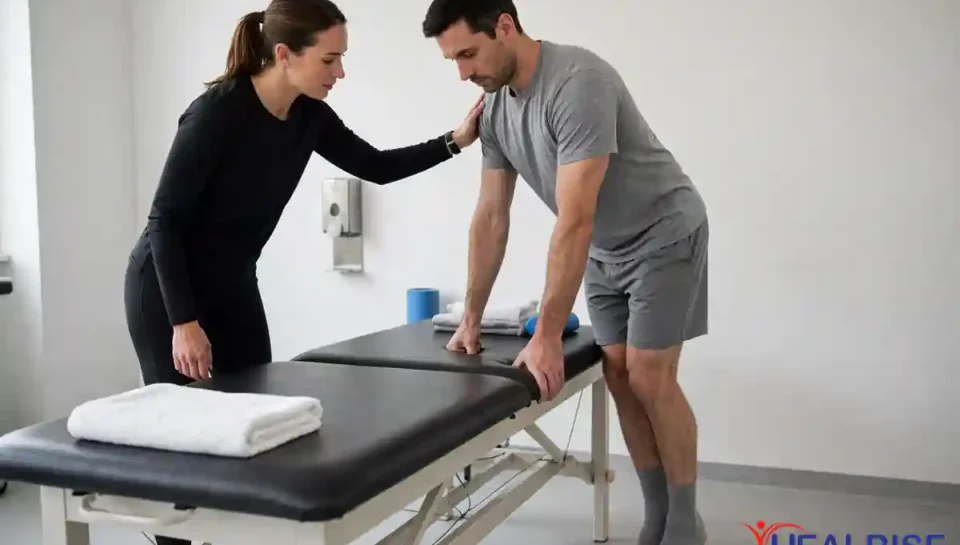
Calf Strain Physiotherapy in Morinville: Heal Strong and Return to Sport Safely
Intro
Calf strain physiotherapy Morinville runners, hockey players, and weekend warriors ask about usually starts with one sharp moment: you push off to sprint, jump for a ball, or take off on the ice, and feel a sudden pull, grab, or pop at the back of your lower leg. One step you are fine. The next step you are limping and cannot push off. It happens in rec hockey, soccer, running, gym training, and weekend yard work across Morinville.
The good news is that most calf strains heal well with the right plan. The bad news is that they also come back easily if you rush. A calf that feels fine at walking pace can still be far from ready for sprinting or jumping. This guide explains what a calf strain is, how the grades work, what to do in the first few days, how calf strain physiotherapy Morinville care at Healrise Physiotherapy and Wellness rebuilds strength step by step, and how to return to running and sport without tearing it again.
Table of Contents
Table of Contents
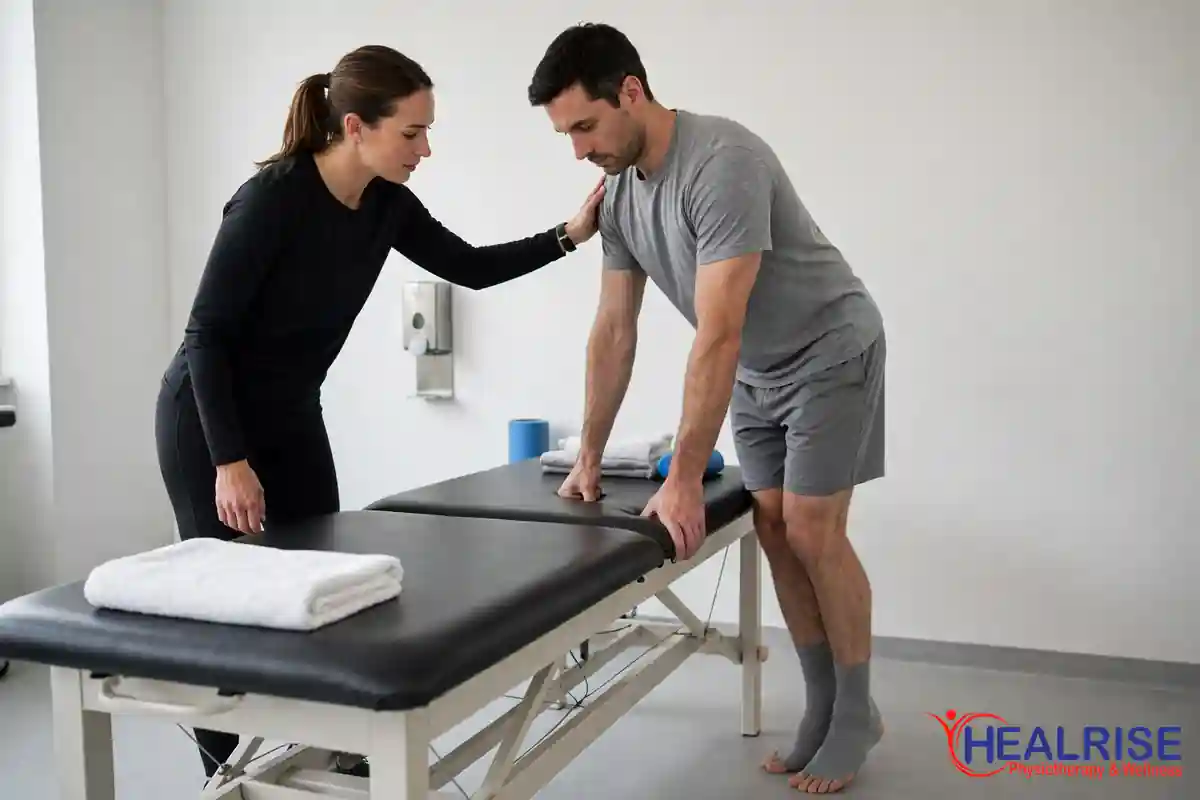
What Is a Calf Strain?
Your calf is made up of two main muscles at the back of your lower leg. The gastrocnemius is the larger, visible muscle that forms the bulge of your calf. It crosses both the knee and the ankle, so it works hardest when your knee is straight and you push off with your foot, like when you sprint, jump, or climb stairs. The soleus sits underneath it, deeper and flatter, and crosses only the ankle. It does most of the work when your knee is bent and during steady activities like walking and standing.
Together, the gastrocnemius and soleus join into the Achilles tendon, which attaches to your heel bone. They lift your heel when you walk and run and absorb force every time your foot lands.
A calf strain, often called a pulled calf or torn calf muscle, happens when some of those muscle fibres are stretched beyond what they can handle and tear. Calf muscles work hardest when the muscle is lengthening under load at the same time, which happens when you push off suddenly, change direction, jump, or land awkwardly. Most calf strains involve the inner head of the gastrocnemius, the upper inner part of the calf, because that area takes the most load during push-off.
Which muscle is injured matters. A gastrocnemius strain hurts higher in the calf with a straight knee; a soleus strain feels deeper and lower and can be slower to settle. Your physiotherapist tests both. The biggest recovery factor is the grade.
Grade 1: mild strain. Only a small number of fibres are overstretched. You feel a definite twinge or tightness in the calf, you can usually still walk, and your strength is close to normal. Grade 1 strains settle quickest, often within 2 to 3 weeks with proper care.
Grade 2: partial tear. A larger portion of the muscle is disrupted, with clear pain, reduced strength, a limp, and bruising a day or two later. This is the most common grade we see. It needs a staged rebuild and commonly takes 4 to 8 weeks before a graded return to sport.
Grade 3: severe or complete tear. The muscle tears fully, sometimes with a visible gap or dent in the calf. Pain is intense, walking is very difficult, and bruising and swelling are heavy. Grade 3 tears need prompt medical assessment and occasionally surgical input. Recovery is measured in months, typically 3 to 6 months, not weeks.
Only an in-person assessment can grade your strain properly and tell whether the gastrocnemius, the soleus, or both are involved.
Symptoms of a Calf Strain
A calf strain usually announces itself clearly. The most common signs are:
Sudden pain at the back of the lower leg. A sharp pull, grab, or pop during push-off, sprinting, jumping, or a sudden change of direction. Many people can point to the exact spot with one finger, often in the upper inner calf.
Pain when you push off or rise onto your toes. Pointing your foot downward against resistance, or rising onto your toes, loads the injured fibres and hurts. Walking uphill or up stairs is often painful.
Weakness and stiffness. The leg feels weak on push-off and the calf feels tight for days.
Bruising and swelling. Bruising often appears within 24 to 72 hours with grade 2 and 3 strains.
A limp or shortened stride. You shorten your step and avoid pushing off.
Tenderness to touch. The injured spot is sore when pressed, and sometimes you can feel a small dip or gap in grade 3 tears.
If two or more sound familiar, assessment comes before loading.
What Causes Calf Strains?
Calf strains rarely happen by pure bad luck. Usually several factors stack up until one sprint or jump is the final straw. The main contributors are:
Sudden push-off and sprinting. The faster you run, the harder the calf works to push your body forward and absorb landing forces. Top-speed efforts, jumps, and sharp direction changes, especially when you are tired, are the classic setting for a tear.
Weak calf muscles. Calves that are weak, especially in the lengthened position, cannot absorb sprinting and jumping forces. Previous injury is the strongest risk factor: a torn calf is far more likely to tear again, especially in the first weeks back.
Fatigue and poor load management. Most strains happen late in a game or after a sudden jump in training: full-speed sprints, hill repeats, speed work, or a full match after weeks off spike load faster than the muscle can adapt.
Tightness and limited ankle movement. A stiff ankle and tight calf force the muscle to work harder through a smaller range. Stiff hips and weak glutes also matter: when the glutes do not share the work of pushing you forward, the calves take more of the load.
Age and cold muscles. Calf strains become more common after age 30 as muscle elasticity slowly declines. Sprinting on cold, unprepared muscles, especially in an Alberta winter, raises the risk further.
Footwear and surface changes. A lower-heeled shoe or a new running surface can suddenly increase calf load.
These causes mean the muscle must be rebuilt stronger, in the exact positions where it tore. That is what physiotherapy does.
Calf Strain or Something Else?
Several problems feel similar to a pulled calf at first, and the treatment is different for each one. A calf strain physiotherapy Morinville assessment at Healrise checks for these look-alikes:
Achilles tendon problems. Pain low in the calf, right at the back of the heel, that is stiff in the morning and warms up with activity often comes from the Achilles tendon rather than the muscle. A sudden pop low in the calf with an inability to push off at all can mean an Achilles rupture, which needs urgent medical care. Our guide to Achilles tendonitis treatment in Morinville explains how tendon pain differs from a muscle strain and how it is rehabbed.
Ankle injuries. A calf strain often comes with a rolled ankle, or the other way around. If your ankle is swollen, bruised, or unstable, our guide to ankle sprain physiotherapy in Morinville covers how ankle sprains are graded and rebuilt.
Shin pain. Pain along the front or inner shin bone during running points to shin splints or, occasionally, a stress injury rather than a calf strain. Our guide to shin splints treatment in Morinville explains how shin pain is assessed and managed.
Hamstring and knee problems. Pain higher up, at the back of the thigh, is more likely a hamstring strain. Our guide to hamstring strain physiotherapy in Morinville covers back-of-thigh tears, and our guide to knee pain physiotherapy in Morinville covers knee pain that can change how you load your calf, including the front-knee ache in our guide to runner’s knee treatment in Morinville.
Blood clot (DVT). This is the one to take seriously. One-sided calf swelling, warmth, redness, or tenderness that worsens without a clear injury, especially with no obvious pull or pop moment, needs same-day medical care to rule out a deep vein thrombosis. Do not try to exercise through unexplained one-sided calf swelling.
Other sports injuries. Calf strains often come with other problems: an ankle roll, a hamstring pull, or knee pain from a fall. Our guide to sports injury physiotherapy in Morinville covers how we assess and rehab the full range of sports injuries. Tell your physiotherapist about every ache, not just the calf, so we fix the whole chain.
Imaging is rarely needed for grade 1 or 2 strains; diagnosis comes from history, palpation, and strength testing of both calf muscles.
Calf Strain Physiotherapy Morinville: How Treatment Works
Physiotherapy is the main treatment for calf strains, and the evidence behind progressive loading is strong. Clinical practice guidelines for calf muscle injuries, summarized for patients by the Journal of Orthopaedic and Sports Physical Therapy, recommend early gentle movement, then progressive strengthening, then a graded return to running and sport. Most resolve within 2 to 8 weeks; grade 3 tears take months. Rest alone is not enough: a muscle that is fully rested heals weaker and less organized, and re-injury rates are high when people return on feel alone.
Here is what treatment at Healrise usually includes:
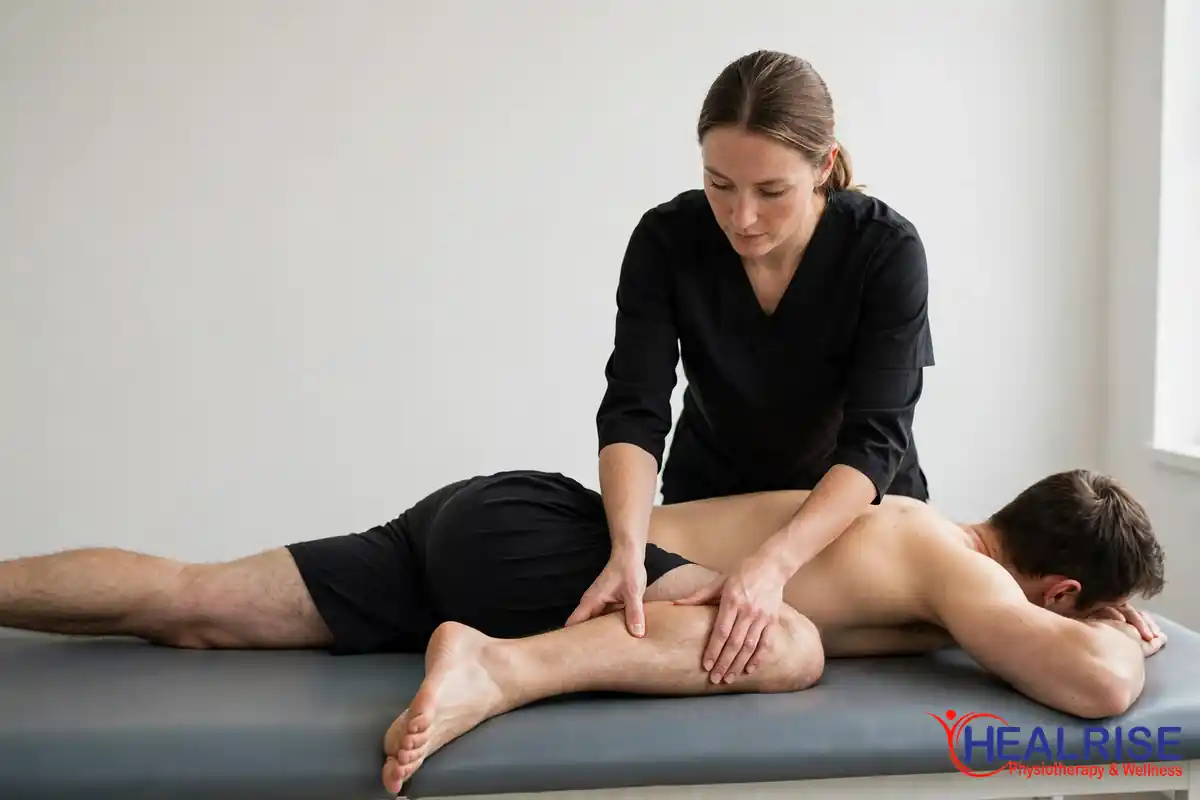
A full assessment and grading. Your physiotherapist asks how it happened, checks where the pain sits, feels for tenderness or a gap, and tests strength, flexibility, and walking. Heel raises with the knee straight test the gastrocnemius, while heel raises with the knee bent test the soleus. Your ankle, knee, hip, and lower back are checked too.
Calming the muscle down in the first few days: the PRICE approach. The early goal is to protect the tear without shutting the muscle away completely. For the first 48 to 72 hours, follow PRICE: Protect the leg by avoiding sprinting, jumping, and sharp pain; Rest relative to the injury, meaning easy walking only; Ice for comfort, 15 to 20 minutes at a time with a barrier on the skin; Compression with a bandage or sleeve to limit swelling; and Elevation, raising the leg above heart level when you can.
A small heel lift or a shoe with a raised heel often makes walking much more comfortable in the first week, because it takes stretch off the healing calf. Gentle, pain-free ankle movements are encouraged: lightly used muscle heals better than fully rested muscle. One clear warning: do not forcefully stretch a freshly torn calf to try to loosen it. Pulling hard on torn fibres can enlarge the tear.
Progressive strengthening, stage by stage. This is the heart of calf strain physiotherapy Morinville care. Stage one uses isometric holds to switch the calf back on safely, such as pressing the ball of your foot gently into the floor without moving. Stage two adds double-leg calf raises on flat ground, rising onto both toes and lowering slowly. Stage three moves to single-leg calf raises, then to calf raises off a step for a fuller range. Stage four, key for preventing re-injury, is loaded and eccentric strengthening, where the muscle produces force while lengthening, including slow lowers off a step and calf raises with added weight in a backpack or held dumbbell. Both straight-knee raises (gastrocnemius) and bent-knee raises (soleus) are trained. You move to the next stage only when the current one is comfortable, not on a fixed calendar.
Hands-on care and movement retraining. Soft tissue work, gentle mobilization, and taping can ease pain while strength rebuilds. Your physiotherapist also retrains walking and running so load is shared properly.
A graded return to running and sport. Running starts only when you can walk briskly, climb stairs, and complete single-leg calf raises without pain. Begin with easy walk-jog intervals on flat ground, build distance before speed, and leave sprinting, jumping, and sharp direction changes for last. Before full return, your calf strength should be at least 90 percent of the other side, you should have no pain, full movement, and be able to complete sport-specific drills like sprints, hops, and direction changes at full speed with no calf pain.
Timelines vary by grade. Grade 1 strains often return to sport in 2 to 3 weeks. Grade 2 strains commonly need 4 to 8 weeks. Grade 3 tears take 3 to 6 months and may need specialist input. Full sprinting usually returns later than you feel ready for, and that gap is where people get caught out.
Exercises for Calf Strain Recovery
The exercises below are the ones most often used in calf strain physiotherapy Morinville programs. They are described so you know what to expect, not as a do-it-yourself prescription. Start any program under a physiotherapist’s guidance, keep pain mild and never sharp during exercise, and stop any movement that causes a sudden pull, swelling, or limping afterward. Warm up first with easy walking.
Isometric calf holds (early phase). Sit with your foot flat on the floor and press the ball of your foot gently down as if starting a calf raise, without lifting your heel. Hold 20 to 30 seconds, then relax. Repeat about 5 times, once or twice daily in week one. These static contractions load the muscle safely and switch it back on without lengthening.
Double-leg calf raises. Stand holding a table or counter for balance, rise up onto both toes as high as comfortable, then lower slowly over 3 seconds. Do 2 to 3 sets of 10 to 15, once or twice daily. This is the foundation exercise, before any single-leg work.
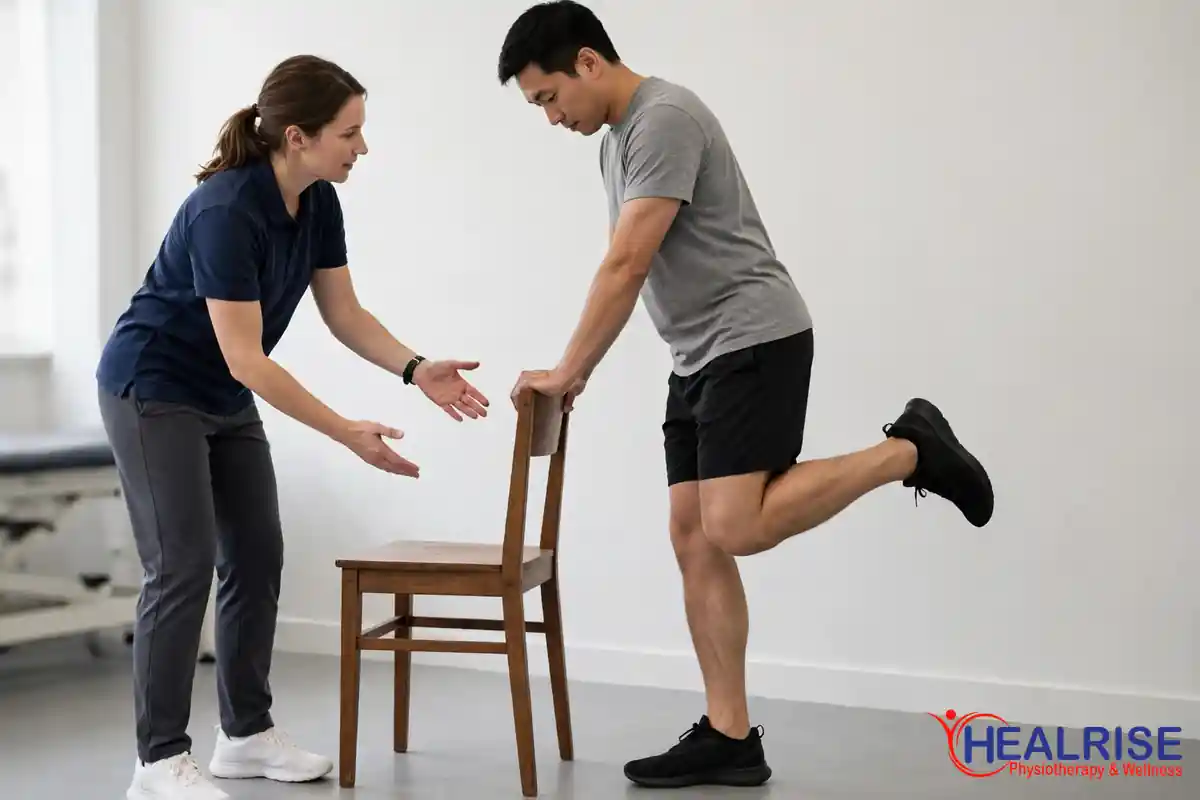
Single-leg calf raises. Stand on one leg holding a chair for balance, rise onto your toes, then lower slowly. Do 2 to 3 sets of 8 to 12 on each side. The injured calf should eventually match the other side in height, control, and repetitions.
Calf raises off a step (later phase). Stand with the balls of your feet on the edge of a step, rise onto your toes, then lower your heels just below the step level for a gentle stretch, then rise again. Do 2 to 3 sets of 8 to 12. The fuller range strengthens the calf in its lengthened position, which is where strains happen.
Loaded and eccentric calf work (later phase). Eccentric work, where the muscle produces force while lengthening, is the most important stage for preventing re-injury, because it rebuilds strength in the exact position where calves tear. Options include slow lowers off a step, rising with both legs and lowering on one, and calf raises with a backpack or dumbbell adding load. Bent-knee raises target the deeper soleus. Start with low numbers, perhaps 2 sets of 6 to 8 controlled repetitions, and build gradually. Expect muscle soreness, not sharp pain. This stage is never rushed and never started in the first days after a tear.
What to avoid for now. Sprinting, jumping, hopping, hill running, aggressive stretching, and full-speed direction changes load healing fibres heavily. They are paused, not banned, then reintroduced one at a time. Easy cycling, pool walking, and flat walking keep you fit without flaring the injury. Avoid the common mistakes: returning too soon, stretching hard, and skipping the loaded eccentric work.
Consistency beats intensity.
What to Expect at Healrise
Your first visit is an assessment, usually about an hour. Your physiotherapist will ask how the injury happened, where it hurts, what helps or worsens it, and your goal: work, running, hockey, soccer, or the gym. Bring any imaging reports.
Then comes the physical assessment: tear location, calf strength testing, ankle movement, and walking quality. You will leave with your grade explained and a staged plan.
You do not need a referral to book. Most extended health benefit plans in Alberta cover physiotherapy, and direct billing is available for many plans. Healrise Physiotherapy and Wellness is at Unit 101, 10507 100 Ave, Morinville, Alberta, T8R 1A2. Call 587-485-0787 or book online through healrisephysiotherapy.ca.
Calf strain physiotherapy Morinville care at Healrise is honest about timelines. We cannot promise you will sprint pain-free in a week after a grade 2 tear. We can promise a proper assessment, a progressive program matched to your grade, and clear return-to-sport testing, including checking that your calf strength reaches at least 90 percent of the other side, so you go back when the muscle is ready, not just when it feels okay.
Calf Strain or Surgery?
Surgery is rarely needed for calf strains. The vast majority of grade 1 and grade 2 strains heal well with progressive physiotherapy. Surgery is considered mainly for complete grade 3 tears with a large gap in the muscle, and for persistent problems after a full course of proper rehab. A complete Achilles tendon rupture is a different injury and may need surgical or specialist care. Even when surgery is done, physiotherapy afterward is essential to rebuild strength and return to sport.
If surgery is mentioned for a partial tear before a structured strengthening program, ask what conservative care has been tried first. For most people, calf strain physiotherapy Morinville care is both the first and final treatment needed.
When to See a Doctor Urgently
Most calf strains are safe to manage with physiotherapy over weeks. But some signs need prompt medical care. Go to urgent care or the hospital, or call your doctor the same day, if you notice:
A sudden pop with immediate severe pain, or an inability to push off or walk. This can indicate a severe or complete tear, or an Achilles tendon rupture.
One-sided calf swelling, warmth, redness, or tenderness that worsens without a clear injury. This is the key red flag for a blood clot (deep vein thrombosis). If your calf swells and feels warm or tender with no obvious pull or pop moment, get same-day medical care. Do not massage it or try to exercise through it.
Large bruising, or a gap or dent you can feel in the calf muscle. This points to a more serious tear that needs proper assessment.
Numbness, tingling, or shooting pain down the leg. This may suggest nerve involvement rather than a simple muscle strain.
Pain that is rapidly getting worse, or a leg that will not bear weight. Worsening pain after an injury always deserves medical review.
Also book soon if pain is not improving after a few days or the same calf keeps pulling when you run.
Preventing Calf Strains From Coming Back
Once the pain settles, the goal is to keep it settled. Calf strains have a high re-injury rate, mostly in the first weeks back when the muscle feels fine but is not yet strong. Keep these habits year-round, especially through Alberta winters.
Keep loaded calf strength work in your routine. Single-leg calf raises, step raises, and slow eccentric lowers, progressed gradually, best protect the muscle in its lengthened position. Keep them going after you feel recovered, and keep both straight-knee and bent-knee work in the program so the gastrocnemius and soleus both stay strong.
Build load gradually. Increase load in small steps, roughly 10 percent per week at most.
Warm up properly. Five to seven minutes of easy movement before sprinting. Never sprint cold.
Train the hips and ankles too. Strong glutes and mobile ankles reduce calf load.
Respect fatigue. Most tears happen when tired, so stop when form breaks down.
Do not skip the return-to-sport steps. Walk briskly, climb stairs, single-leg raises, jog, run, sprint, jump, change direction: in that order, pain-free at each step, with calf strength at least 90 percent of the other side before full return.
Calf strain physiotherapy Morinville programs at Healrise finish with a prevention plan, because getting you pain-free is only half the job. Keeping you playing is the other half.
Frequently Asked Questions
How long does a pulled calf take to heal?
It depends on the grade. Grade 1 often allows a graded return within 2 to 3 weeks. Grade 2 commonly takes 4 to 8 weeks. Grade 3 can take 3 to 6 months and may need specialist input. Most calf strains resolve within 2 to 8 weeks with progressive rehab, but full sprinting returns later than daily activity.
Should I stretch a pulled calf?
Gentle, pain-free movement helps, but aggressive stretching of a freshly torn muscle does not: it can enlarge the tear. Avoid deep calf stretching in the first few days. Focus on gentle ankle movement and progressive strengthening, especially loaded eccentric work. Flexibility work returns later, dosed to comfort.
When can I run again after a calf strain?
Only once you can walk briskly, climb stairs, and complete single-leg calf raises without pain, with calf strength at least 90 percent of the other side. Begin with an easy walk-jog progression on flat ground, build distance before speed, and leave sprinting, jumping, and sharp turns until last. Before full return you should have no pain, full movement, and be able to complete sport-specific drills at full speed with no calf pain. A graded return over weeks protects you far better than a single test run.
Should I use ice or heat on a calf strain?
In the first 48 hours, ice helps pain and swelling, 15 to 20 minutes at a time with a barrier on the skin. Avoid heat early, as it can increase bleeding into the tear. Later, gentle heat before exercise can ease stiffness but never replaces strengthening. Stop either if sharp pain increases.
Do I need a referral to book physiotherapy in Morinville, and is it covered by insurance?
No referral is needed; book directly with Healrise Physiotherapy and Wellness. Bring imaging or a referral letter if you have them, but they are not required. Most Alberta extended health plans cover physiotherapy, often with direct billing. Work injuries may be covered by WCB Alberta, and motor vehicle accidents by accident benefits. Our front desk can confirm your coverage.
Disclaimer
This article is general information only, not medical advice. The right treatment depends on your own assessment and grade. Seek urgent care for a pop with severe pain, inability to push off or walk, a muscle gap, numbness or shooting leg pain, or one-sided calf swelling with warmth or redness without a clear injury. Speak with a physiotherapist or doctor before starting any exercise program.
Book Your Assessment
If that sudden pull in your calf still limits every step, stair, and run, assessment is the first step. Calf strain physiotherapy Morinville athletes and active people trust is available at Healrise Physiotherapy and Wellness. We will grade your strain, explain it in plain words, and build a staged plan to rebuild strength and return you to sport safely. No referral needed. Call 587-485-0787 or book online through healrisephysiotherapy.ca. Healrise Physiotherapy and Wellness is at Unit 101, 10507 100 Ave, Morinville, Alberta, T8R 1A2. Book an assessment today and take the first step toward healing strong and staying healed.