by

If you rolled your ankle on the field or the sidewalk, you are not alone. Ankle sprains are one of the most common injuries we treat, and early care makes a real difference. If you are looking for ankle sprain physiotherapy in Morinville, this guide explains what happened, what to do in the first days, and how step-by-step rehab gets you back to work and sport safely.
Table of Contents
What Is an Ankle Sprain?
An ankle sprain happens when your ankle twists or rolls beyond its normal range, stretching or tearing the ligaments, the strong bands of tissue holding your ankle bones together. Most sprains happen when the foot rolls inward, stretching the ligaments on the outside of the ankle.
It happens in sport, but also from stepping off a curb, missing a stair, or slipping on ice in an Alberta winter.
Mild vs. Severe Sprains: Understanding the Three Grades
- Grade 1 (mild): Ligaments stretch but barely tear. You can usually still walk, and recovery takes one to three weeks.
- Grade 2 (moderate): Some ligament fibers tear. Swelling and bruising are more obvious, walking is quite painful, and recovery takes three to six weeks.
- Grade 3 (severe): The ligament tears fully. The ankle may feel loose or unstable, and you may not bear weight on it at all. Recovery takes two to three months with careful rehab.
A higher grade does not automatically mean surgery. Most sprains, even full tears, heal without it when managed well.
What to Do in the First Few Days After a Sprain
Protect the ankle. Rest it for a day or two and avoid anything that causes sharp pain. Once you can bear weight without severe pain, short easy walks help; use crutches for a few days if you need them.
Use ice and elevation. Apply a cold pack wrapped in a thin towel for 15 to 20 minutes a few times a day, and raise your foot above heart level when you rest.
Avoid heat, alcohol, and deep massage in the first 48 hours, since these can increase swelling. If you are unsure how serious your sprain is, book an assessment early.
What to Expect From Ankle Sprain Physiotherapy in Morinville
Your first ankle sprain physiotherapy in Morinville session pinpoints exactly what was injured and how badly. Your physiotherapist checks how your ankle moves and which directions hurt, the amount of swelling and bruising, the strength of the muscles around your ankle and lower leg, your balance, and how you walk.
You leave with a clear diagnosis, a rehab plan with realistic timelines, and a home program for between visits.
Rehab Stages: Mobility, Strength, Balance, and Proprioception
At Healrise, ankle sprain physiotherapy in Morinville follows clear stages that build on each other, so your ankle heals strong, not just pain-free for a while.
Stage 1 restores mobility. Gentle ankle circles, tracing the alphabet with your toes, and guided joint movements bring back pain-free motion. Your therapist may also use hands-on manual therapy joint work.
Stage 2 rebuilds strength. You progress from resistance band pulls to calf raises and step work, since weak ankle muscles are a top reason sprains happen again.
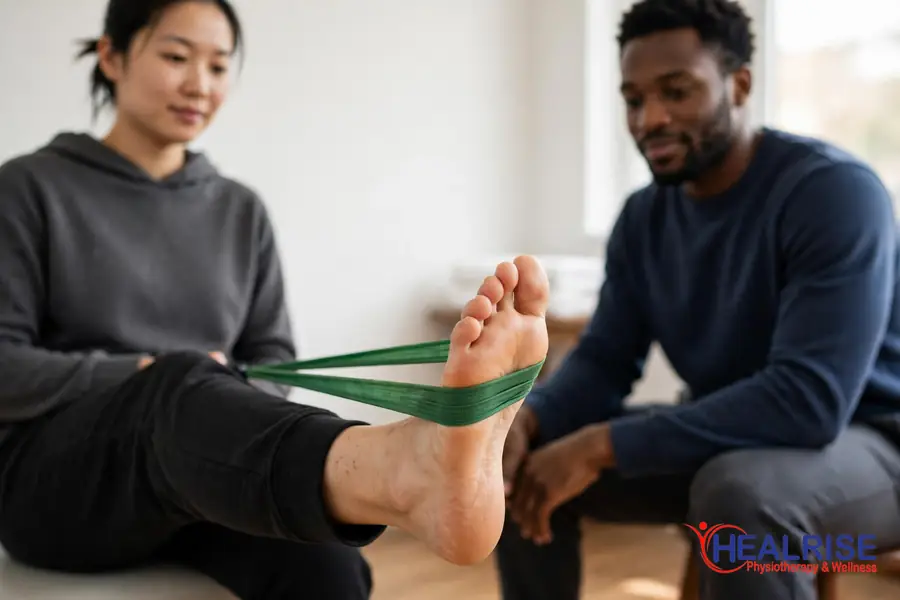
Stage 3 rebuilds balance and proprioception, your ankle’s sense of position. After a sprain this sense goes quiet, which is why the ankle keeps rolling. Single-leg stands, wobble cushions, and balance boards retrain it. This is the stage most often skipped by people rehabbing on their own.

Stage 4 rebuilds agility and power. Hopping, cutting, and quick direction changes restore confidence, and your therapist tests both ankles side by side before clearing you.
Returning to Work and Sport Safely
Going back too soon is the most common mistake after an ankle sprain. Your ankle is ready when swelling stays down, strength matches your other side, and balance feels steady even when you are tired.
Desk workers with mild sprains can often return within a few days. Jobs involving standing, lifting, ladders, or uneven ground need more time and a strength test first.
For sport, the final phase of ankle sprain physiotherapy in Morinville adds sport-specific drills, and clear testing before your first full game protects you from a second, worse injury.
Preventing Repeat Sprains
About one in three people sprain the same ankle again, often because rehab stopped too early. Good ankle sprain physiotherapy in Morinville continues until the ankle is genuinely strong, not just pain-free.
Prevention means balance exercises two to three times a week for at least three months, home exercises for calf and ankle strength, supportive footwear, and an ankle brace for high-risk activities in your first season back.
If your ankle has rolled more than once, tell your physiotherapist. That points to ankle instability, which needs a longer plan but still responds well to the right exercises.
Warning Signs: When to Get Checked Promptly
Most sprains can start with physiotherapy right away, but see a doctor or urgent care if: you cannot bear any weight on the foot or the ankle gives way completely, swelling is severe or bruising spreads quickly up the leg, the ankle looks deformed, you feel numbness or tingling in the foot, or pain does not improve after a few days of good home care.
In Alberta, you do not need a doctor’s referral to see a physiotherapist. If you notice any of these signs, contact us, or check MyHealth Alberta’s ankle sprain page for guidance.
Why Choose Ankle Sprain Physiotherapy in Morinville at Healrise
Ankle sprains respond best to hands-on care and guided exercise, not just a printout. At Healrise, your plan is built around your grade of sprain, your job, and your sport.
Treatment combines manual therapy, progressive strengthening, and balance training, with regular re-tests to prove your ankle is truly ready. Our broader Physiotherapy services also cover related knee, hip, or back issues.
Lead physiotherapist Dipak Chunara works with athletes, weekend warriors, and anyone who wants to walk without fear of the next roll.
Frequently Asked Questions
1. How long does an ankle sprain take to heal?
Mild sprains heal in one to three weeks, moderate sprains in three to six weeks, and severe sprains in two to three months. Early physiotherapy often shortens these timelines.
2. Can I walk on a sprained ankle?
Short gentle walks are fine if you can bear weight with only mild pain. If walking causes sharp pain or your ankle gives way, use crutches and get assessed first.
3. Do I need a doctor’s referral for physiotherapy in Alberta?
No, you can book directly without seeing a doctor first. If your assessment shows signs needing a doctor’s opinion, your physiotherapist will guide you.
4. When can I return to sport after an ankle sprain?
When swelling stays down, strength and balance match your uninjured side, and you can finish sport-specific drills pain-free. For moderate sprains, that is usually three to six weeks. Returning too early is the top cause of repeat sprains.
5. Why does my ankle keep rolling?
Repeated rolling usually means the first sprain never fully healed, leaving weak ligaments, poor balance sensors, or weak ankle muscles. A focused program of proprioception and strength training can fix this, even months later.
Book Your Assessment at Healrise Physiotherapy & Wellness
Do not let a sprained ankle turn into a long-term problem. Early, guided care is the fastest route back to the life you enjoy.
Healrise Physiotherapy & Wellness
Unit 101, 10507 100 Ave, Morinville, AB T8R 1A2, Canada
Phone: 587-485-0787
Email: info@healrisephysiotherapy.ca
Lead physiotherapist: Dipak Chunara
Direct billing available. No doctor’s referral needed in Alberta.
Call Healrise today to start your ankle sprain physiotherapy in Morinville, or reach us through our Contact page.