 by

Intro
Spinal stenosis physiotherapy Morinville patients rely on starts with a simple question: how far can you walk before your legs start to ache? For many people over 60, the answer keeps shrinking. A trip to the grocery store, a walk around the block, or standing in the kitchen to make dinner becomes a countdown. Your legs feel heavy, your calves cramp, or a dull ache spreads down your thighs, and the only thing that helps is sitting down or leaning forward on a shopping cart.
That pattern has a name: neurogenic claudication, the hallmark of lumbar spinal stenosis. It happens when the space inside the spinal canal narrows and squeezes the nerves that run down to your legs. The good news is that most people improve without surgery. Research shows 70 to 80 percent of patients manage their symptoms well with conservative care, and clinical guidelines recommend spinal stenosis physiotherapy Morinville care as the first treatment to try.
Table of Contents

What Is Spinal Stenosis?
Your spine is a stack of bones called vertebrae. Running down the middle of that stack is the spinal canal, a bony tunnel that protects the spinal cord and the nerves that branch off it to the rest of your body. Spinal stenosis means that tunnel has narrowed. When the space gets tight, the nerves inside get squeezed, and that pressure causes pain, numbness, tingling, and weakness.
Spinal stenosis most often affects the lower back (lumbar stenosis) and the neck (cervical stenosis). The lower back is by far the more common site, and it is the one this guide focuses on most. Spinal stenosis physiotherapy Morinville care begins with finding out where the narrowing is and how it is affecting your nerves, because the treatment is different for each location. It affects up to 47 percent of people over 60, and it is the most common reason for spinal surgery in adults over 65 in Canada. But surgery is not the first step, and for most people it is never needed.
Lumbar vs Cervical Spinal Stenosis
Spinal stenosis can happen anywhere along the spine, but the two places it matters most are the lower back and the neck. They feel very different, and knowing which one you have shapes the whole treatment plan.
Lumbar spinal stenosis (lower back)
Lumbar stenosis affects the nerves that travel to the legs, most commonly at the L3 to L5 levels. The classic sign is leg pain, heaviness, or cramping that starts after walking or standing for a while and eases when you sit down or lean forward. Many people notice they can walk further when they lean on a shopping cart, push a walker, or walk uphill, because bending forward opens the spinal canal slightly and gives the nerves more room. Lumbar stenosis is often mistaken for hip or knee arthritis, because the pain sits in the same area, so a proper assessment matters.
Cervical spinal stenosis (neck)
Cervical stenosis affects the nerves that travel to the arms and hands, most commonly at the C4 to C7 levels. Symptoms include arm pain, tingling or numbness in the fingers, weaker grip, and clumsiness with fine tasks like buttoning a shirt. In more severe cases it can affect balance and the way you walk. Cervical stenosis needs early attention, because the spinal cord itself can be involved. If you have hand weakness, dropping things, or balance problems along with neck pain, get assessed promptly.
Both types share the same cause and the same first-line treatment, spinal stenosis physiotherapy Morinville care. The exercises differ, but the goal is the same: more space for the nerves, stronger supporting muscles, and better movement.
What Causes Spinal Stenosis?
Spinal stenosis is almost always the result of wear and tear over many years. The spine ages like every other part of the body, and the changes add up until the canal becomes too narrow for comfort. The commonest causes are:
Degenerative disc disease. The discs between your vertebrae act as cushions. With age they lose water and height, and they can bulge into the spinal canal. This is the most common cause of acquired stenosis.
Bone spurs (osteophytes). As discs wear down, the body grows extra bone in response, the same way it does with arthritis in a knee. These bony growths stick into the spinal canal and take up space the nerves need.
Thickened ligaments. A ligament called the ligamentum flavum runs along the back of the spinal canal. With age it thickens and can buckle inward, especially when you stand upright, squeezing the nerves further.
Arthritis of the facet joints. The small joints at the back of each vertebra can develop osteoarthritis. The cartilage wears away, the joints enlarge, and bone spurs form around them, narrowing the openings where nerve roots exit.
Spondylolisthesis and a naturally narrow canal. Sometimes one vertebra slips forward over the one below it, narrowing the canal at that level. Some people are also born with a narrower spinal canal than others, so even small age-related changes cause symptoms earlier, because there was less spare room to begin with.
Farm work, construction, warehouse jobs, and long winters of shovelling snow all load the spine over decades. None of these causes can be reversed, but that does not mean you have to live with the symptoms. Spinal stenosis physiotherapy Morinville treatment works on the parts you can change: muscle strength, flexibility, posture, and the way you move.
Symptoms of Spinal Stenosis
The symptoms of spinal stenosis depend on where the narrowing is, but they share one telltale pattern: they get worse with standing and walking, and better with sitting or bending forward. That pattern is the single most useful clue in the whole condition.
Neurogenic claudication. This is the signature symptom of lumbar stenosis. Pain, cramping, heaviness, or numbness in the buttocks and legs that starts after walking or standing for a while and fades within minutes of sitting or leaning forward. Many people describe it as their legs feeling like lead, or like they are walking through deep snow.
Numbness and tingling. Pins and needles in the legs, feet, or hands, depending on whether the narrowing is in the lower back or the neck. The tingling often follows the path of the squeezed nerve root.
Weakness and balance problems. Legs that feel weak or give way after walking, a foot that drags slightly, or hands that feel clumsy and weak. In cervical stenosis, or in severe lumbar stenosis, balance can suffer too. Weakness that is getting worse is a reason to seek care promptly.
Reduced walking distance. This is the symptom that affects daily life most. A walk that used to take 20 minutes now takes 10 before you need to stop. Errands, gardening, and walking with grandchildren all get cut short.
If your symptoms follow this pattern, getting worse with standing and better with sitting, mention it to your physiotherapist at your spinal stenosis physiotherapy Morinville assessment. That one detail narrows the diagnosis down fast.
Spinal Stenosis or Something Else?
Several conditions feel like spinal stenosis at first, and telling them apart matters because the treatment is different for each one. That is why spinal stenosis physiotherapy Morinville assessments look at the whole picture, not just the scan.
Sciatica. Sciatica is pain that shoots down the leg along the sciatic nerve, usually from a disc problem. It often comes on suddenly, can be sharp or burning, and does not depend as much on posture. Stenosis pain builds up gradually with walking and eases with sitting or leaning forward. Both can exist at the same time. Our guide to sciatica physiotherapy in Morinville explains how we tell them apart.
Hip or knee arthritis. Arthritis in the hip or knee causes pain in the joint itself, often worse first thing in the morning or after sitting for a long time, and it usually eases once you get moving. Stenosis does the opposite: it gets worse the longer you walk or stand.
Vascular claudication. Poor blood flow to the legs also causes cramping when walking. The key difference is that vascular claudication is relieved by rest alone, whatever your posture, while neurogenic claudication is relieved by sitting or bending forward. If your leg pain does not change with posture, tell your doctor, because the blood vessels need checking.
Ordinary back pain. General back pain usually improves with movement and worsens with rest, the reverse of stenosis. Our guide to back pain physiotherapy in Morinville covers the common causes and how we assess them.
These conditions overlap, and imaging alone does not settle it. Many people with narrowing visible on a scan have no symptoms at all. The assessment, not the scan, decides the treatment.
How Physiotherapy Helps Spinal Stenosis
Physiotherapy cannot reverse the narrowing of the spinal canal. No exercise can remove a bone spur or un-thicken a ligament. What physiotherapy can do is reduce the pressure on the nerves, strengthen the muscles that support the spine, and teach you how to move in ways that keep the canal as open as possible. That is why clinical guidelines recommend physiotherapy as the first-line treatment for mild to moderate spinal stenosis, before surgery is even discussed.
A 2024 systematic review of 13 randomized clinical trials found that supervised, multimodal physiotherapy programs significantly improve pain, walking distance, and function in people with spinal stenosis. The evidence is clear: a supervised, personal program works better than a generic handout.
Here is what spinal stenosis physiotherapy Morinville treatment at Healrise usually includes:
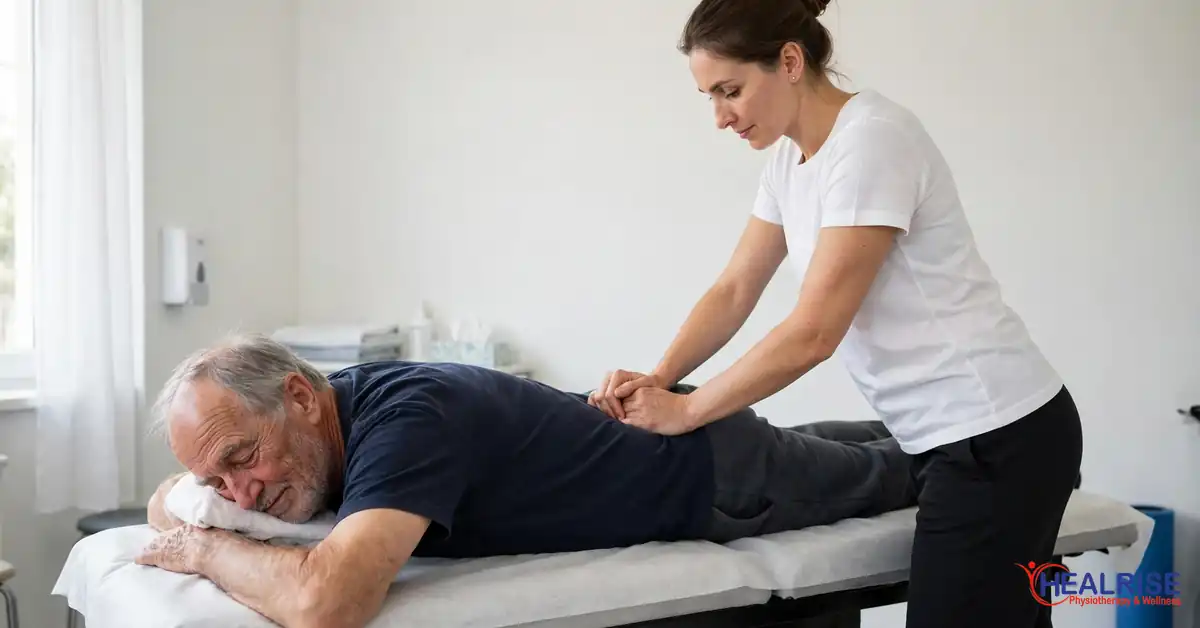
A full assessment first. Your physiotherapist tests your spine, hip strength, walking pattern, balance, and nerve function. They find out which movements open the canal and which ones close it, and how far you can walk before symptoms start. That baseline is what the whole plan is measured against.
Flexion-based exercise. Because bending forward opens the spinal canal and standing upright narrows it, the exercises for stenosis favour gentle forward-bending movements. Knee-to-chest stretches, pelvic tilts, and seated flexion exercises create space for the nerves. Extension exercises, like back bends and prone press-ups, usually make stenosis worse and are avoided.
Core, hip, and aerobic conditioning. The deep muscles of the abdomen and lower back act like a corset for the spine, and strong hips take load off the lower back. Core work for stenosis is gentle and controlled, not sit-ups or heavy lifting. Stationary cycling is ideal too, because the seated, slightly forward-leaning position opens the canal while you exercise. Aquatic therapy works the same way, with the water supporting your weight.
Manual therapy and nerve gliding. Hands-on techniques, including joint mobilisation and spinal distraction, improve movement between the vertebrae and can reduce pressure on the nerves. Gentle nerve gliding exercises help the compressed nerve roots move freely and improve their blood supply, which can reduce radiating pain and tingling in the legs.
Pain education and daily movement training. Understanding why your symptoms behave the way they do reduces fear. Many people with stenosis stop walking because they worry the pain means damage. In most cases the pain is a signal of nerve irritation, not damage, and learning that difference is a core part of spinal stenosis physiotherapy Morinville care. Small changes help too: how you stand at the kitchen counter, how you get up from a chair, and how you carry groceries. Your physiotherapist teaches you the positions that keep the canal open during the things you do every day.
Most people notice real improvement within 6 to 8 weeks of consistent treatment. A full course usually runs 12 to 16 sessions over 2 to 4 months. Chronic or severe cases may benefit from ongoing maintenance sessions to keep the gains. For pain that has lasted months, our guide to chronic pain physiotherapy in Morinville explains how we approach long-standing symptoms.
Exercises for Spinal Stenosis
The exercises below are the ones most often prescribed in spinal stenosis physiotherapy Morinville programs. They are described here so you know what to expect, not as a do-it-yourself program. Every spine is different, and an exercise that helps one person can aggravate another. Start any exercise program under the guidance of a physiotherapist, and stop any movement that causes sharp pain, numbness, or weakness.

Knee-to-chest stretch. Lie on your back, draw one knee gently toward your chest, and hold for 30 seconds. Repeat 3 to 5 times on each side. Try both knees together as well. This creates lumbar flexion passively and often brings immediate relief.
Pelvic tilts. Lie on your back with your knees bent. Gently flatten your lower back against the floor by tightening your stomach muscles, hold for 5 seconds, then release. This teaches the deep core muscles to support the spine.
Seated lumbar flexion. Sit in a chair and slowly bend forward, letting your hands slide down toward your feet. Hold for 10 seconds, then sit back up. This is a practical stretch you can do anywhere, and it is the same position that relieves symptoms when you sit down during a walk.
Walking intervals. Walk until your symptoms reach a mild level, then sit and lean forward for a few minutes until they settle, then walk again. Over weeks, the distance you can cover before needing a break grows. Leaning on a shopping cart or using walking poles during errands creates automatic forward lean and can extend your comfortable walking distance by a lot.
What to avoid. Back extensions, prone press-ups, heavy lifting with poor form, running, jumping, and prolonged standing without breaks can all narrow the canal further and aggravate symptoms. Your physiotherapist will tell you which of your current activities to modify and which to keep.
Consistency matters more than intensity. A short daily routine you actually do beats a long routine you abandon after a week. Spinal stenosis physiotherapy Morinville programs are built around exercises you can keep doing at home, because the benefit comes from doing them regularly, not from doing them once in the clinic.
What to Expect at Healrise
Your first visit at Healrise Physiotherapy and Wellness is an assessment, not a treatment session. It usually takes about an hour. Your physiotherapist will ask about your history: when the symptoms started, what makes them better or worse, how far you can walk, what you have already tried, and what matters most to you. Bring a list of your medicines and any imaging reports you have, because they help complete the picture.
Then comes the physical assessment. Your physiotherapist tests your spinal movement, hip strength, balance, walking pattern, and nerve function, including reflexes and sensation in your legs. They also check your posture in standing and sitting, and watch how you walk, because the way you move tells them a lot about where the pressure is.
After the assessment, you get a clear explanation of what is going on and a plan. The plan includes the exercises you will do in the clinic and at home, the hands-on treatment if it is needed, and realistic goals. A realistic goal for stenosis is usually measured in walking distance: from one block to three, from 10 minutes to 30, from needing a sit-down at the grocery store to finishing the shop without stopping. You do not need a referral to book, and most extended health benefit plans cover physiotherapy, with direct billing available for many plans. Our guide to physiotherapy for seniors in Morinville explains how treatment is adapted for older adults.
Spinal stenosis physiotherapy Morinville care at Healrise is honest about what physiotherapy can and cannot do. It cannot reverse the narrowing, but for most people it reduces the pain, extends the walking distance, and gives back the daily activities stenosis has been taking away.
Physiotherapy or Surgery?
Surgery is sometimes the right answer for spinal stenosis, but it is not the first answer. Spinal stenosis physiotherapy Morinville care is the first answer. Clinical guidelines recommend a 3 to 6 month trial of conservative care, including physiotherapy, before surgery is considered for mild to moderate stenosis. The reason is simple: 70 to 80 percent of people improve with non-surgical treatment, and surgery carries risks and a recovery period that physiotherapy does not.
Surgery is usually considered when conservative treatment has been tried properly for 3 to 6 months without enough improvement, when there is severe and progressive weakness, when bladder or bowel control is affected, or when the loss of function is seriously affecting daily life. Loss of bladder or bowel control, or sudden severe weakness in both legs, is an emergency and needs immediate hospital care, not a physiotherapy appointment.
If surgery does become necessary, spinal stenosis physiotherapy Morinville care is still part of the story. Post-surgical physiotherapy is essential for the best recovery after spinal decompression or fusion surgery, rebuilding strength, movement, and walking confidence. Our guide to post-surgery physiotherapy in Morinville explains what recovery looks like and how we support it.
When to See a Doctor Urgently
Most spinal stenosis is not dangerous, and it can be managed over time. But a few symptoms mean something more serious may be happening, and they need urgent medical attention. Go to the hospital at once, or call emergency services, if you notice any of these:
Loss of bladder or bowel control. New difficulty controlling your bladder or bowels, or numbness in the groin or inner thighs, can indicate cauda equina syndrome. This is a surgical emergency.
Sudden severe weakness in both legs. Weakness that comes on quickly, or a foot that suddenly drops and will not lift, needs immediate assessment.
Rapidly worsening numbness. Numbness spreading quickly, or numbness in the saddle area, is a red flag.
Symptoms after a fall or injury. A fall that causes new leg weakness, numbness, or severe back pain needs prompt medical review.
Fever with back pain. Fever, unexplained weight loss, or back pain that is severe at night and does not change with movement can indicate infection or another serious cause, and needs a doctor's assessment.
Also book a spinal stenosis physiotherapy Morinville assessment soon if your walking distance is shrinking quickly or weakness is getting worse. The earlier stenosis is assessed, the more options you have.
Preventing Spinal Stenosis From Getting Worse
You cannot stop the spine from ageing, but with spinal stenosis physiotherapy Morinville care you can slow the process and keep the symptoms from taking over. The habits that help are the same ones that help almost every spine condition, and they are worth starting now, whatever your age.
Stay active. The worst thing for stenosis is long periods of sitting still. Regular walking, cycling, and swimming keep the spine mobile, the muscles strong, and the nerves supplied with blood. Aim for short, frequent movement rather than one long effort.
Keep the core and hips strong. A few minutes of core and hip exercises most days protects the spine far better than a single weekly session. The muscles are the spine's support system, and they respond to regular use.
Mind your posture and lift well. Slouching in a chair and standing with a swayback both narrow the canal. Sitting with support behind your lower back, and standing tall with your weight evenly spread, keeps the canal as open as it can be. When lifting, bend your knees, keep the load close to your body, and avoid twisting.
Watch your weight and do not smoke. Extra weight loads the spine with every step, and smoking reduces blood flow to the discs and nerves. Both speed up degeneration.
Spinal stenosis physiotherapy Morinville programs include a prevention plan, because the goal is to stay mobile for years, not just feel better for a month.
Frequently Asked Questions
Can physiotherapy cure spinal stenosis?
No, physiotherapy cannot reverse the structural narrowing of the spinal canal. What spinal stenosis physiotherapy Morinville care does very well is manage the symptoms and improve function. A 2024 systematic review of 13 randomized clinical trials confirmed that supervised physiotherapy programs significantly improve pain, walking distance, and function. Most people experience meaningful improvement without surgery, and for many that is enough.
What exercises should I avoid with spinal stenosis?
Extension-based exercises, like back extensions or prone press-ups, should generally be avoided, because they further narrow the spinal canal. High-impact activities like running and jumping, heavy lifting with poor form, and prolonged standing without rest breaks can also aggravate symptoms.
How long does spinal stenosis physiotherapy Morinville treatment take?
Most people notice meaningful improvement within 6 to 8 weeks of consistent physiotherapy. A full course typically runs 12 to 16 sessions over 2 to 4 months. Chronic or severe cases may benefit from ongoing maintenance sessions to preserve function and prevent flare-ups.
Do I need a referral to book physiotherapy in Morinville?
No. You can book directly with Healrise Physiotherapy and Wellness without a doctor's referral. If you have imaging reports or a referral letter from your doctor, bring them along, as they help your physiotherapist plan your assessment, but they are not required.
Is spinal stenosis physiotherapy covered by insurance in Alberta?
Most extended health benefit plans in Alberta cover physiotherapy, typically with an annual limit. Direct billing is available for many plans. If you were injured at work, WCB Alberta may cover your treatment, and if your stenosis was aggravated by a motor vehicle accident, accident benefits may apply.
Disclaimer
This article is for general information only and is not medical advice. Every spine is different, and the right treatment depends on your own assessment. If you have severe symptoms, sudden weakness, or loss of bladder or bowel control, seek urgent medical care. Always speak with a physiotherapist or your doctor before starting any exercise program.
Book Your Assessment
If walking is getting harder and your legs ache every time you stand for too long, a proper assessment is the first step. Spinal stenosis physiotherapy Morinville residents trust is available at Healrise Physiotherapy and Wellness. We will assess your spine, explain what is going on in plain words, and build a plan around your goals. No referral needed. Call (780) 924-9568 or book online through healrisephysiotherapy.ca. Healrise Physiotherapy and Wellness is at 10507 100 Ave, Morinville, Alberta. Book an assessment today and take the first step toward walking further with less pain.