by

Reaching for a top shelf, throwing a ball, or simply sleeping on your side should not hurt. But when your rotator cuff is unhappy, even small movements can sting. If that sounds like your shoulder, rotator cuff physiotherapy in Morinville may be the fastest way back to comfortable movement. The rotator cuff is one of the most common reasons adults visit a physiotherapist, and most cases get better without surgery when treatment is done right.
This guide explains what the rotator cuff is in plain words, the symptoms to watch for, how a tear differs from tendinitis, the five steps of treatment, home habits that speed up healing, recovery timelines, and the warning signs that mean you should get checked soon.
Table of Contents
What Is Your Rotator Cuff?
Your rotator cuff is a group of four small muscles and their tendons that wrap around your shoulder joint like a cuff. Their job is to hold the ball of your upper arm bone snugly in its socket while the bigger muscles move your arm. Think of them as the steady hands that keep the joint centered.
Because these muscles work every time you lift, reach, pull, or throw, they are under constant demand. Over time, or after one awkward moment, the tendons can become irritated, inflamed, or torn. That is when pain, weakness, and stiffness show up. If shoulder pain is new to you, our shoulder pain physiotherapy in Morinville guide covers the broader picture.
7 Rotator Cuff Symptoms That Call for Physiotherapy in Morinville
Rotator cuff problems tend to follow a familiar pattern. Watch for these signs:
- Sharp pain when you lift your arm, rotate it, or reach behind you.
- A dull, aching pain at rest or when you sleep, especially if you roll onto that shoulder.
- Weakness that makes lifting objects feel harder than it should.
- Trouble reaching overhead or behind your back, like fastening a bra strap or tucking in a shirt.
- A painful arc, where lifting the arm hurts most between about halfway up and near the top, then eases off.
- Clicking, popping, or grinding sensations when you move the shoulder.
- Night pain that wakes you up or keeps you from falling asleep on that side.
Night pain is one of the hallmark signs. Many people tell us they can manage during the day but cannot find a comfortable sleeping position. If two or more of these sound familiar, an assessment for rotator cuff physiotherapy in Morinville is worth your time.
Rotator Cuff Tear vs Tendinitis vs Impingement: What Is the Difference?
These three terms get mixed up constantly, so here is the simple version.
Tendinitis (sometimes called tendinopathy) means the tendon is irritated and struggling to cope with load. It is the most common type and usually builds slowly over weeks or months of overuse.
Impingement means the tendon or the bursa around it gets pinched between bones when you lift your arm. Poor posture, weak shoulder blade muscles, or a bone shape that narrows the space can all contribute. Impingement often comes with that painful arc described above.
A tear means some or all of the tendon fibers have separated. Small partial tears can happen from wear and tear alone, often without a clear injury. Full tears usually follow a fall onto an outstretched arm or a sudden heavy lift. Tears bring more weakness and sometimes a popping sensation at the moment of injury.
The good news is that physiotherapy is the recommended first step for all three, including many tears. Surgery is reserved for cases that do not respond to good conservative care. The OrthoInfo patient guide from the American Academy of Orthopaedic Surgeons has a clear overview of rotator cuff tears if you want the medical detail.
How Rotator Cuff Physiotherapy in Morinville Works: 5 Steps
A rotator cuff does not heal well by accident. It needs the right load at the right time, and that is exactly what a structured program of rotator cuff physiotherapy in Morinville provides. Here are the five steps we use at Healrise:
- A proper assessment first. The first session of rotator cuff physiotherapy in Morinville always starts with testing, not treating. We check how your shoulder moves, test the strength of each rotator cuff muscle, look at how your shoulder blade moves, and screen your neck and upper back, because stiffness there can overload the shoulder. The plan has to match your exact problem, not just the diagnosis name.
- Calm the pain. In the early days we use gentle techniques to settle the shoulder: hands-on manual therapy to ease stiffness, guidance on ice and activity changes, and simple pain-free movement so the joint does not get stiff. Rest alone is rarely the answer, because a shoulder that stops moving gets worse.
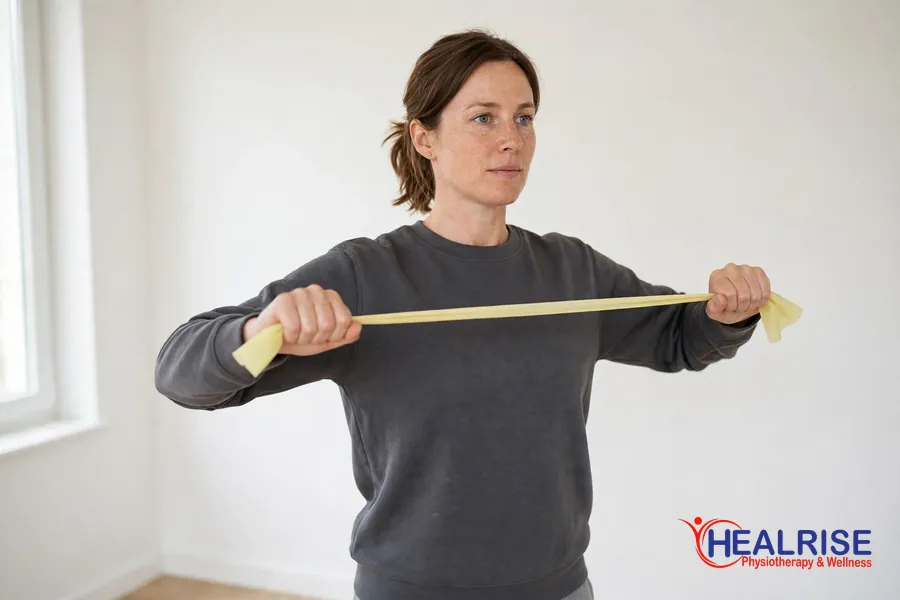
- Rebuild strength gradually. This is the core of recovery. We start with gentle holds and light band work, then progress to heavier, more demanding exercises as the tendon adapts. The key rule is simple: some discomfort during exercise is fine, but sharp pain or pain that lingers for hours afterward means we pushed too far.
- Fix the movement pattern. Many rotator cuff problems come back because of how the shoulder moves, not just how strong it is. We coach your shoulder blade to glide smoothly, improve your posture, and clean up lifting technique so the tendon stops getting pinched.
- Return to what you love. Once strength and movement are back, we bridge you into real life: overhead sports, heavy lifting, or simply sleeping through the night. For athletes, our sports injury physiotherapy in Morinville program adds sport-specific drills before full return.
For stubborn tendon pain that has lasted months, we may add shockwave therapy to restart the healing process. You can read how it works in our shockwave therapy in Morinville guide.
Home Habits That Speed Up Recovery
What you do between visits matters as much as what happens in the clinic. These habits help most people:
Pendulum swings. Lean forward with your good hand on a table and let the sore arm hang relaxed. Gently swing it in small circles, forward and back, then side to side, for a minute or two. This keeps the joint moving without loading the tendon.
Use ice early, heat later. In the first few days of a flare-up, ice for 10 to 15 minutes helps settle pain. Once things calm down, gentle heat before exercises can loosen the shoulder.
Sleep smarter. Try lying on your back with a small pillow under the sore arm, or on your good side hugging a pillow so the sore shoulder stays supported. Avoid sleeping directly on the painful shoulder.
Keep it close. When lifting, keep objects close to your body instead of reaching far out. The further the weight is from you, the harder your rotator cuff works.
Move, do not guard. It is natural to protect a sore shoulder, but holding it still for weeks leads to stiffness. Gentle, pain-free movement several times a day is better than complete rest.

How Long Does a Rotator Cuff Take to Heal?
This is the question everyone asks, and the honest answer is that it depends on the severity.
For mild tendinitis or impingement caught early, most people who start rotator cuff physiotherapy in Morinville notice real improvement within 4 to 6 weeks, with steady gains after that. Moderate cases and partial tears typically take 8 to 12 weeks to rebuild tendon strength properly. Full tears treated without surgery, or recovery after rotator cuff surgery, can take 3 to 6 months of guided rehab.
Tendons heal slowly because they have less blood supply than muscles. That is normal, not a sign that something is wrong. What matters is the trend: gradually less pain, gradually more strength, gradually more movement. Rushing back to heavy overhead work before the tendon is ready is the most common reason people re-injure it.
Warning Signs: When to Get Help Fast
Most rotator cuff problems are not emergencies, but a few signs deserve prompt attention:
- Sudden, severe weakness or inability to lift your arm after a fall or injury
- A shoulder that looks deformed or sits in a strange position
- Numbness, tingling, or a cold feeling in the arm or hand
- Shoulder pain with fever, redness, or warmth around the joint
- Pain that steadily worsens over days instead of improving
If any of these apply, get checked the same day rather than waiting.
Rotator Cuff FAQs
Can a rotator cuff tear heal without surgery?
Many can, especially partial tears. Physiotherapy rebuilds the strength of the remaining muscle and the other shoulder muscles so the joint works well even with a damaged tendon. Surgery is usually considered only when good conservative care has not worked after several months, or for large tears in younger, active people.
Do I need an MRI before starting physiotherapy?
No. A thorough hands-on assessment is enough to start treatment in most cases. Imaging is useful when we suspect a large tear, when progress stalls, or when surgery is being considered. Starting physiotherapy first does not delay anything.
Should I wear a sling for rotator cuff pain?
Usually not. Short-term use right after an acute injury is fine, but wearing a sling for days or weeks lets the shoulder stiffen and the muscles weaken. Gentle, pain-free movement is almost always better.
Can I still exercise with a rotator cuff problem?
Yes, with smart changes. Lower-body training, walking, and cardio are usually fine. For the upper body, avoid overhead pressing, heavy bench press, and any movement that produces sharp pain. Your physiotherapist can adjust your routine so you stay active while the shoulder heals.
Why does my shoulder hurt more at night?
Night pain is classic for rotator cuff problems. Lying down increases blood flow and pressure around the inflamed tendon, and certain sleeping positions compress it. The sleep tips in the home habits section above usually help, and night pain is often one of the first things to improve with treatment.
Book Your Rotator Cuff Assessment in Morinville
Shoulder pain does not have to become your normal. Rotator cuff physiotherapy in Morinville at Healrise Physiotherapy and Wellness starts with a proper assessment, builds a plan around your life, and guides you back to pain-free movement step by step. No doctor’s referral is needed, and we offer direct billing to most insurance plans.
Visit us at 10507 100 Ave Unit 101, Morinville, AB, or call +1 587-485-0787 to book. We are open 7 days a week, and walk-ins are welcome.