by
Intro
You start running again after a break, or you add a few extra kilometres to your week. The first runs feel fine. Then a dull ache starts along the inside of your shin, just above the ankle. It fades when you stop, but it comes back earlier on the next run. Soon it hurts to walk down the stairs in the morning.
That is shin splints, and it is one of the most common running injuries in the world. It is painful, frustrating, and very treatable, but only if you understand what it is and what to do about it. Resting for a week and then running the same way as before almost always brings it back.
This guide explains shin splints treatment in Morinville in plain language: what shin splints are, why they happen, how to tell them apart from a stress fracture, the treatment options that work, the exercises that fix the cause, and a safe plan to get back to running.
Table of Contents
What Are Shin Splints?
Shin splints is the common name for medial tibial stress syndrome. It is pain along the inner edge of the shin bone, the tibia, usually in the lower two-thirds of the leg. It happens when the muscles, tendons, and bone tissue around the shin are overloaded, faster than they can adapt.
When you run, every step sends a shock through your lower leg. The calf muscles pull on the shin bone, and the bone itself bends very slightly with each impact. In a healthy, well-trained leg, the tissues adapt and get stronger. But when the load increases too quickly, through more distance, more speed, harder surfaces, or new shoes, the tissues become irritated and inflamed before they have time to adapt. That irritation is shin splints.
There are two main types:
Medial shin splints. Pain along the inner, back edge of the shin bone. This is the common type, and it is the one most runners get. It is linked to overuse, flat feet, and weak calf and shin muscles.
Anterior shin splints. Pain along the front of the shin, in the muscle at the front of the leg. This type is less common and is often linked to running downhill, walking or running on hard surfaces, and a muscle imbalance between the front and back of the leg.
Most people who come to us have the medial type. The treatment is similar for both, but the exercises and the return-to-running plan are adjusted to the type and the cause.
Causes of Shin Splints
Shin splints are almost always a load problem, not a single event. The tissues were asked to do more than they were ready for. The usual triggers are:
Too much, too soon. The number one cause. You increase your weekly distance by more than about 10 percent, add hill training or speed work, or return to running after a break at your old pace. Your fitness may be ready, but your bones and tendons adapt more slowly than your heart and lungs.
Hard or uneven surfaces. Running on concrete, or switching suddenly from a treadmill to pavement, increases the impact on your shins. Downhill running is especially hard on the front of the shin.
Worn-out or wrong shoes. Running shoes lose their cushioning after 500 to 800 kilometres. Old shoes, or shoes that do not suit your foot type, change the way your foot hits the ground and increase the load on the shin. If your shoes are worn on the inside edge, that is a clue.
Flat feet or overpronation. When the arch of the foot collapses inward with each step, the shin muscles work harder to control the movement. Over time, that extra work irritates the tissues along the shin bone.
Weak calves and shin muscles. The calf muscles absorb shock when you run, and the muscles at the front of the shin lift your toes clear of the ground. When either group is weak, the shin bone takes more of the load. Weak hips and glutes also matter, because they control how the leg lines up with each step. If you have weak hips, your knee can collapse inward when you run, which loads the shin unevenly. Our guide to knee pain physiotherapy in Morinville explains how hip strength affects the whole leg.
Tight calves. Tight calf muscles limit how far the ankle can bend. When the ankle cannot bend enough, the foot hits the ground harder and the shin takes more stress.
Training on a treadmill, then switching outside. Treadmill running is softer and more even than road running. Switching to outdoor running too quickly, especially on concrete, is a common trigger in winter, when Morinville runners move from indoor treadmills to outdoor roads in spring.
Symptoms of Shin Splints
Shin splints usually start gradually. The early signs are easy to ignore, which is why the problem often gets worse before people seek help.
- A dull ache along the inner edge of the shin, usually in the lower half of the leg
- Pain that starts during a run and fades when you stop, at first
- Tenderness when you press along the shin bone
- Mild swelling along the inner shin
- Pain that comes on earlier in each run as the problem progresses
- Aching or stiffness in the shins when you walk, climb stairs, or get out of bed in the morning
- Pain in one leg, or both legs at the same time
In the early stage, the pain appears only during exercise and settles with rest. In the later stage, it can hurt during normal walking and daily activities. If the pain has reached that point, it is time to get assessed, because the tissues need a proper plan, not just rest.
Shin Splints or Stress Fracture? Know the Red Flags
This is the most important section in this guide. Shin splints and a tibial stress fracture can feel similar at first, but they are very different problems. A stress fracture is a small crack in the shin bone, and it needs a very different approach, including a period of protected rest and often a walking boot.
See a physiotherapist or doctor promptly if you notice any of these red flags:
- Pain in one very specific spot on the shin bone, that you can point to with one finger, rather than a broad ache along the bone
- Pain that hurts even at rest, or that wakes you at night
- Pain when you hop on one leg, or when you walk, not just when you run
- Swelling that does not settle, or a visible bump on the shin
- Pain that keeps getting worse over days or weeks despite rest
- A recent large increase in training, or a history of low bone density, eating problems, or irregular periods (in women), which raise stress fracture risk
A physiotherapist can screen for a stress fracture with a hands-on examination and specific tests. If a stress fracture is suspected, you will be referred for imaging, usually an MRI, because X-rays often miss early stress fractures. Do not try to run through a suspected stress fracture. It can turn a small crack into a complete fracture.
If you have pain in the Achilles tendon as well as the shin, you can read our guide to Achilles tendonitis treatment in Morinville to understand how the two problems are connected.
7 Ways Physiotherapy Helps Shin Splints
Physiotherapy treats shin splints by finding the cause, not just calming the pain. Here are the 7 ways it helps.
1. A Proper Assessment
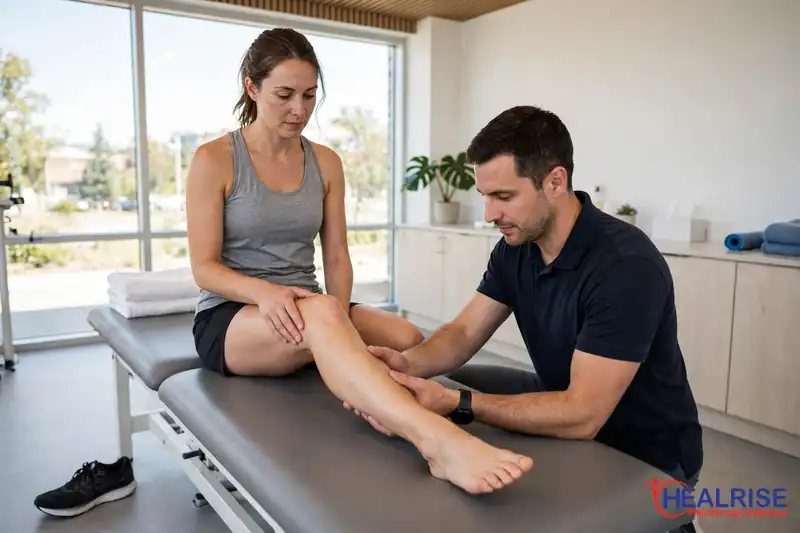
Treatment starts with finding out exactly what is overloaded and why. The physiotherapist checks your running history, your shoes, your foot shape, your ankle flexibility, your calf and hip strength, and the way you run. They also screen for stress fracture red flags. The result is a clear diagnosis and a plan built around your body and your training, not a generic handout.
2. Load Management
The most important part of treatment is also the hardest to accept: you need to reduce the load on your shin, but not stop moving completely. Your physiotherapist will help you find the training level that keeps the tissues healing without losing your fitness. That usually means shorter runs, softer surfaces, less speed work, and cross-training like cycling or swimming while the shin recovers. Total rest is rarely the answer, because the tissues need some load to heal and adapt.
3. Manual Therapy
Hands-on treatment can reduce pain and improve movement in the calf, ankle, and foot. Soft tissue release eases tight calf muscles, joint mobilisation improves ankle flexibility, and massage reduces muscle soreness. The goal is to make the leg move better, so the shin takes less stress with each step.
4. Strengthening the Calves and Shins
Weak calves are the most common finding in shin splints. Your physiotherapist will build a strengthening program for the calf muscles, the shin muscles at the front of the leg, and the small muscles of the foot. The exercises are progressed gradually, so the tissues get stronger without flaring up. Strong calves absorb shock better, which is the single best protection against shin splints coming back.
5. Hip and Glute Strength
The hips control how the leg lines up when you run. Weak hip muscles let the knee collapse inward, which loads the shin unevenly. Strengthening the glutes and hips improves your running form and takes pressure off the shin. This is often the missing piece for runners who keep getting shin splints despite resting.
6. Gait and Running Form Advice
Small changes in running form can make a large difference. Your physiotherapist may look at your cadence (steps per minute), your stride length, and where your foot lands. A slightly quicker cadence with shorter steps reduces the impact on the shin. Landing with your foot under your body, rather than far in front, also helps. These changes are introduced gradually, so they do not cause new problems.
7. A Graded Return-to-Running Plan
The final step is a structured plan to get you back to full running without a relapse. The plan increases distance and intensity in small steps, with rest days built in, and clear rules for when to push on and when to back off. Runners who follow a graded plan are far less likely to get shin splints again than runners who simply wait until the pain stops and then resume their old training.
Exercises for Shin Splints
These are general exercises your physiotherapist may teach you. Do not start them on your own if your pain is severe, if you have a specific tender spot on the bone, or if you have not been assessed yet. Your physiotherapist will confirm which ones are safe for you and how many repetitions to do.
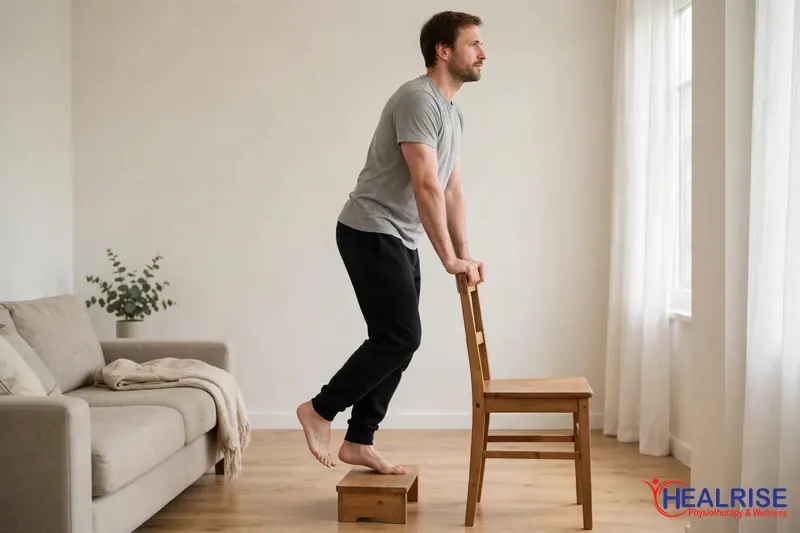
Calf raises. Stand on the edge of a step, holding a rail or wall. Rise up on your toes, hold for 2 seconds, and lower slowly below the step. Repeat 10 to 15 times. As you get stronger, do them on one leg. This is the single most important exercise for shin splints.
Toe walks. Walk on your toes for 20 to 30 metres, keeping your knees straight. This strengthens the calf muscles and the small muscles of the foot.
Heel walks. Walk on your heels for 20 to 30 metres, with your toes lifted off the ground. This strengthens the muscles at the front of the shin, which control the foot when it hits the ground.
Tibialis raises. Sit with your back against a wall and your legs straight out in front of you. Lift your toes toward your shins, hold for 2 seconds, and lower slowly. Repeat 15 times. This directly targets the muscle that lifts the foot and supports the shin.
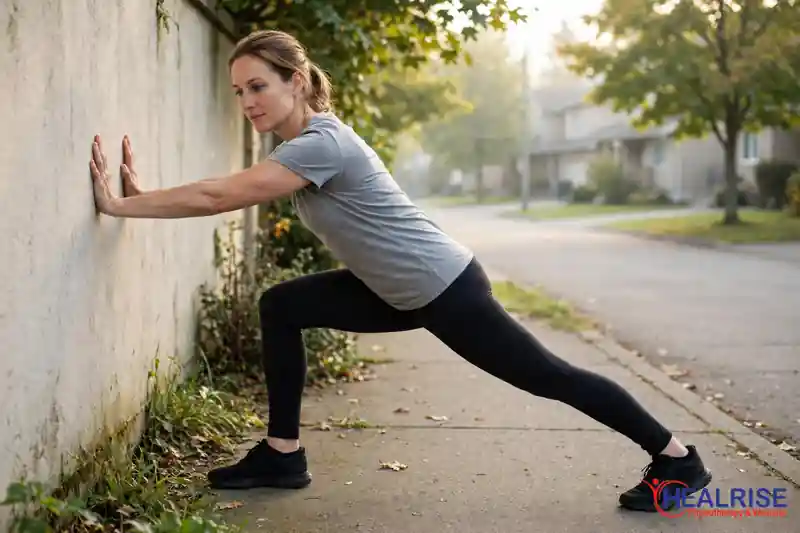
Calf stretch. Stand facing a wall, one foot in front of the other. Keep the back leg straight and the heel on the floor, and lean forward until you feel a stretch in the back calf. Hold for 30 seconds. Repeat 3 times on each side. Then bend the back knee slightly to stretch the deeper calf muscle.
Ankle alphabet. Sit with your leg outstretched and trace the letters of the alphabet in the air with your big toe. This improves ankle mobility and wakes up the small muscles around the ankle and shin.
Do these exercises 3 to 4 times a week. Mild discomfort that settles within a few minutes is normal. Sharp pain, or pain that lasts for hours afterward, means you did too much, and you should tell your physiotherapist so the program can be adjusted.
Footwear and Training Tips
Shoes and training habits matter as much as exercises. A few simple changes can prevent shin splints from coming back.
Replace your shoes on time. Running shoes lose their cushioning after 500 to 800 kilometres. If you run 20 kilometres a week, that is about 6 to 9 months. Write the purchase date inside the shoe, or track your distance in a running app.
Get the right shoe for your foot. If you overpronate (your arch collapses inward), a stability shoe or an insole can help. If you have flat feet and shin splints keep coming back, custom orthotics may be worth discussing with your physiotherapist. You can read our guide to plantar fasciitis treatment in Morinville to understand how foot mechanics affect the whole leg.
Follow the 10 percent rule. Increase your weekly running distance by no more than about 10 percent per week. If you run 20 kilometres this week, run no more than 22 next week. The same rule applies to speed work and hill training: add one new thing at a time, not all at once.
Run on softer surfaces when you can. Grass, trails, and a track are gentler on your shins than concrete. Mix up your surfaces, and avoid running every run on the same hard route.
Warm up and cool down. Start each run with 5 minutes of easy walking or slow jogging, and finish with gentle calf stretches. Cold, tight calves are more likely to get injured.
Cross-train. Cycling, swimming, and pool running keep your fitness up while giving your shins a break. They are not a replacement for running, but they are a useful part of the recovery plan. Our guide to sports injury physiotherapy in Morinville explains how cross-training fits into injury recovery.
A Safe Return-to-Running Plan
Here is a general framework your physiotherapist may use. It is not a prescription, and the exact numbers depend on your assessment, but it shows how a graded return works.
Week 1 to 2: Walk pain-free, cross-train, and do your strengthening exercises. No running yet. The shin should be pain-free during daily walking before you run.
Week 3: Start with walk-run intervals on a soft surface. For example, 1 minute of easy running followed by 2 minutes of walking, repeated 5 times, every second day. Stop if the pain rises above 3 out of 10 during the run, or if it is worse the next morning.
Week 4 to 5: Increase the running intervals gradually. For example, 2 minutes running and 1 minute walking, then 3 minutes running and 1 minute walking. Keep the total running time short and the pace easy.
Week 6 to 8: Run continuously for 20 to 30 minutes on soft surfaces, every second day. Add 10 percent to your weekly total each week, as long as the pain stays low and settles within 24 hours.
Week 8 and beyond: Return to your normal routes and pace, and reintroduce speed work and hills one at a time. Keep doing your calf and shin exercises twice a week, even after you feel better. That is what keeps the shin splints from coming back.
The golden rule is simple: pain during a run should stay below 3 out of 10, and it should settle within 24 hours. If it does not, you did too much, and you should step back a level for a few days.
When to See a Physiotherapist
Book an assessment if any of these sound familiar:
- Shin pain that keeps coming back, run after run
- Pain that starts earlier in each run, or that now hurts when you walk
- A specific tender spot on the shin bone, or pain at rest or at night
- Swelling along the shin that does not settle
- You have rested for two weeks and the pain came straight back when you ran again
- You are training for a race and cannot afford to lose weeks to trial and error
- You have had shin splints before and they keep returning
You do not need a doctor’s referral to see a physiotherapist in Alberta. You can book directly. And the best time to come is early, when the problem is still a mild irritation, not after it has become a stress fracture. If you have had an ankle sprain in the past and your ankle still feels unstable, it is worth reading our guide to ankle sprain physiotherapy in Morinville, because ankle instability changes the way you run and can contribute to shin pain.
Frequently Asked Questions
How long do shin splints take to heal?
Most mild cases improve in 2 to 4 weeks with load management and the right exercises. More stubborn cases, or cases where the pain has been present for months, can take 6 to 12 weeks. The biggest factor is how early you start treatment and whether you follow the graded return-to-running plan. Runners who rest completely and then resume their old training often take the longest to recover, because the cause was never fixed.
Should I stop running completely?
Usually not. Complete rest is rarely needed for shin splints, unless a stress fracture is suspected. Most runners can keep some running, at a reduced distance and intensity, on softer surfaces, while they do their strengthening program. Your physiotherapist will help you find the level that keeps the tissues healing without losing your fitness. Stopping completely and then restarting at full volume is the most common reason shin splints come back.
Do I need new shoes?
Maybe. If your shoes are worn out, or if they do not suit your foot type, new shoes can help. But shoes alone rarely fix shin splints. The cause is usually a combination of training load, weak calves, and running form. New shoes help most when they are part of a full plan: better shoes, better strength, and a smarter training progression.
Can I run through shin splints?
No. Running through shin splints usually makes them worse, and it can turn a mild irritation into a stress fracture. The pain is your body telling you the tissues are overloaded. The right approach is to reduce the load, fix the cause, and build back gradually. That feels slower, but it is faster in the end, because it prevents the months-long recovery a stress fracture needs.
Will shin splints come back?
They can, but they do not have to. Runners who keep doing their calf and shin exercises, follow the 10 percent rule, replace their shoes on time, and listen to early warning signs rarely get shin splints again. The runners who get them repeatedly are usually the ones who stop the exercises as soon as the pain goes away and go straight back to their old training. Keep the exercises in your routine, even when you feel fine.
Get Back to Running Pain-Free
Shin splints are frustrating, but they are very treatable. The runners who recover fastest are the ones who get assessed early, fix the cause rather than just resting, and follow a graded plan back to full training. Waiting and hoping the pain goes away on its own is the one approach that consistently makes things worse.
If you run in or around Morinville and your shins have been hurting, book an assessment at Healrise Physiotherapy and Wellness. We will find out exactly what is overloaded, explain it in plain language, and build a plan that gets you back to running, pain-free, and keeps you there.
Healrise Physiotherapy and Wellness
10507 100 Ave, Unit 101, Morinville, AB T8R 1A2
Phone: +1 587-485-0787
Website: www.healrisephysiotherapy.ca
Book your shin splints assessment today and take the first step back to pain-free running.