 by
ACL rehabilitation Morinville patients trust starts close to home, and it is the key to getting back on your feet, back to work, and back to the sport you love after an ACL injury. A torn ACL can feel like the end of your season, or even the end of the activities that make you who you are. But with the right plan, most people return stronger and more confident than before. Rehabilitation, not just surgery, is what makes that possible.
The anterior cruciate ligament, or ACL, is a small band of tissue inside your knee that keeps the shin bone from sliding forward and gives your knee stability when you twist, pivot, or land from a jump. When it tears, your knee can feel loose, swollen, and unreliable. Some people hear a pop at the moment of injury. Others feel their knee give way when they try to turn or stop quickly.
This guide explains what ACL rehabilitation Morinville involves, what the first 12 months look like, which exercises rebuild your knee, and how you know when you are ready to return to sport. Everything here is written in plain language, and it reflects how we work with patients at Healrise Physiotherapy and Wellness in Morinville.
This guide is for you if you tore your ACL playing sport, at work, or in a fall; if you are waiting for ACL surgery; if you already had surgery and want to recover well; or if you are deciding whether surgery is even needed. You do not need any medical background to follow it. Every section answers a question our patients ask us in the clinic, from how long recovery takes to when you can run again.
Table of Contents
What Is ACL Rehabilitation and Do You Always Need Surgery?
ACL rehabilitation Morinville is a guided program of exercise, hands-on treatment, and education that helps you move again after an ACL tear. It is for you whether or not you have surgery, and it runs in phases: first calm the knee down and get it moving, then build strength, then train balance and control, and finally prepare you for your sport. It is not a set of generic exercises printed from the internet. At Healrise, the program is built around your knee, your sport, and your goals, and it changes as you progress.
Surgery is not always needed. Some people, especially those who do not play pivoting sports and whose knee feels stable in daily life, do very well with physiotherapy alone. These people are sometimes called “copers”: their muscles learn to protect the knee, and they return to walking, work, and light activity without an operation. Others, especially athletes in soccer, basketball, hockey, skiing, or volleyball, usually need ACL reconstruction surgery because their sport demands the stability only a new ligament can provide. The decision is made together with your surgeon and your physiotherapist, based on your age, your activity level, how unstable the knee feels, and whether other structures like the meniscus are damaged.
Whether or not you have surgery, ACL rehabilitation Morinville is what decides the outcome. Surgery rebuilds the ligament, but rehabilitation rebuilds the muscle, the control, and the confidence that let you trust your knee again. If you have surgery, physiotherapy starts within days and is the key to the success of that surgery. If you choose not to have surgery, a good program can still get you back to daily life and to many sports.
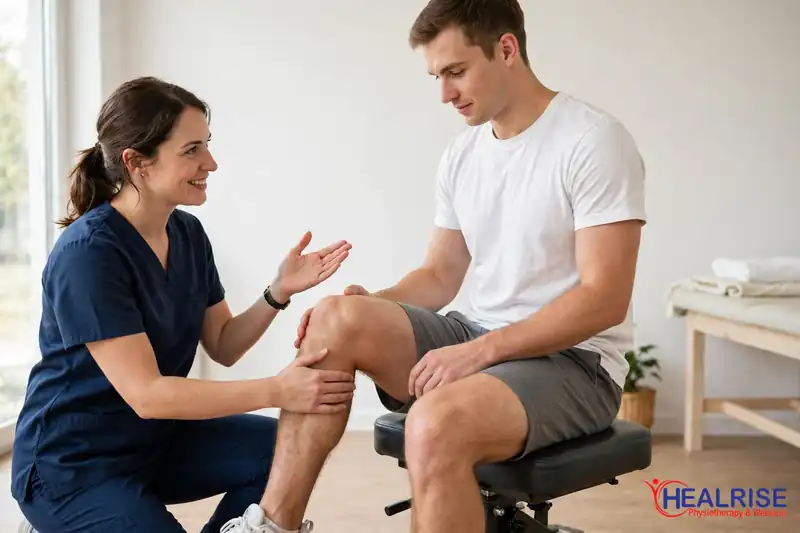
ACL rehabilitation Morinville physiotherapists provide starts with a full assessment. Your physiotherapist will check your swelling, how far your knee bends and straightens, how strong your quadriceps and hamstrings are, how you walk, and what your goals are. From that, they build a plan around your life, whether that means returning to the soccer field, getting back to a physical job, or simply walking down stairs without worry.
If your knee problem is wear and tear rather than a ligament injury, our guide to knee replacement rehabilitation in Morinville follows a different step-by-step path for arthritic knees.
For your first appointment, wear shorts or loose clothing so your physiotherapist can see and move your knee easily. Bring your surgeon’s notes or discharge instructions if you have them, a list of your medications, and any brace you were given. Your physiotherapist will want to see how you walk, how your knee moves, and how much it hurts, so they can set the starting point for your program.
How an ACL Tear Happens: The Signs You Should Not Ignore
Most ACL tears happen without any contact at all. The classic story is a sudden stop, a quick change of direction, a pivot on a planted foot, or an awkward landing from a jump. It is one of the most common serious knee injuries in soccer, basketball, hockey, skiing, and volleyball, but it can also happen at work or in a simple fall on ice.
The signs of an ACL tear are usually clear. Many people hear or feel a pop inside the knee at the moment it happens. Swelling often builds up within a few hours. The knee feels painful, stiff, and hard to fully straighten or bend. Walking feels unsteady, and the knee may give way when you try to turn or stop. Some people can still walk, but the knee feels loose and unreliable, like it cannot be trusted.
If this sounds like your injury, do not wait to get it checked. In the first days, rest the knee, ice it for 15 to 20 minutes several times a day, use a compression bandage if you have one, and keep the leg raised on pillows. Avoid twisting or pivoting on the injured leg. Then book an assessment as soon as you can. Early physiotherapy reduces swelling, restores movement, and protects the knee while you and your surgeon decide on the next steps. Starting early almost always means a smoother recovery, whether surgery is planned or not.
Seek medical care promptly if your knee locks and will not straighten, if you cannot put any weight on the leg, if you have numbness in the foot, or if the pain is severe and not settling. These signs need a doctor’s attention right away.
Not every knee injury is an ACL tear. Ligament sprains, meniscus injuries, and kneecap problems can feel similar at first. Our guide to knee pain physiotherapy in Morinville explains how we sort out which structure is injured and what each one needs.
Your ACL Rehabilitation Morinville Timeline: 9 to 12 Months, Phase by Phase
Most ACL rehabilitation Morinville plans follow the same broad pattern, but the pace is personal. Your age, your strength before the injury, the type of surgery you had, and your surgeon’s instructions all shape the timeline. Use this guide as a map, not a race.
The most important idea in modern ACL rehabilitation Morinville is that progress is based on tests, not on dates. You move to the next phase only when your knee passes its checks, which is why two people can be at different phases at the same time. This is safer and faster in the long run than pushing through on a fixed calendar. For a plain-language overview of ACL injury aftercare, including rest, ice, compression and elevation, see MedlinePlus.
Phase 1: Protection and Early Motion (Weeks 0-2)
The first two weeks are about protecting the healing knee while getting it moving again. The goals are to control swelling, regain full knee extension, wake up the quadriceps muscles, and reach about 90 degrees of bending. Full extension, getting the knee completely straight, is the single most important early goal. A knee that cannot straighten fully in the first weeks often stays stiff, and that stiffness affects walking for months.
Exercises in this phase are gentle: quad sets, where you tighten the thigh muscle and press the back of the knee down; heel slides, where you slowly slide your heel toward you to bend the knee; ankle pumps to keep blood moving; and gentle kneecap glides to keep the joint from stiffening. You will walk with crutches and a brace if your surgeon advises it, and your physiotherapist will show you how to move safely around the house.
Phase 2: Early Strengthening (Weeks 2-6)
By week six, the goals are at least 120 degrees of bending, walking without a limp, and lifting the leg straight without the knee sagging. Exercises progress to stationary cycling with light resistance, mini squats, step-ups, leg press through a limited range, and balance board work. Most people stop using crutches in this phase, when their physiotherapist agrees their walking pattern is safe.
This is also when many people feel frustrated. The fast gains of the first two weeks slow down, and the knee still feels weak. That is normal. Keep doing your home exercises every day. Small, steady gains add up, and your physiotherapist will adjust the plan so you keep moving forward.
Phase 3: Progressive Strengthening (Weeks 6-12)
In weeks six to twelve, exercises become properly challenging: squats, lunges, hamstring curls, calf raises, full-range leg press, single-leg exercises, and advanced balance training. Your walking should look normal by now, and stairs should feel easier. Your physiotherapist will test your strength and compare your injured leg with your good leg to decide when you are ready for the next phase.
Phase 4: Advanced Strengthening (Months 3-6)
Between three and six months, the new ligament is going through a process called ligamentization, where the graft tissue slowly turns into ligament. During this time the graft is actually at its weakest, so this is not the time to rush. The goals are quadriceps strength of at least 70 percent of the other leg, good single-leg control, and straight-line running, usually around four to five months if your strength tests allow it. Plyometric exercises begin here, starting with both legs before moving to one leg.
Phase 5: Return to Sport (Months 6-12)
The final phase is about sport itself: agility drills, jumping and cutting, landing practice, and sport-specific conditioning. You return to full sport only when you pass objective tests, which are covered in detail later in this guide. Each month you wait before returning to pivoting sport, up to nine months, lowers your risk of tearing the ACL again.
In ACL rehabilitation Morinville patients often ask how soon they can run again. A rough guide: walking normally by about six weeks, straight-line jogging around four to five months if strength tests allow, agility and cutting drills from six months onward, and full return to pivoting sport at nine to twelve months, only after passing your return-to-sport tests.
- Weeks 0-2: swelling controlled, knee fully straight, 90 degrees of bending, walking with crutches.
- Weeks 2-6: 120 degrees of bending, walking without a limp, straight leg raise without sagging.
- Weeks 6-12: normal walking and stairs, squats and lunges, single-leg strength building.
- Months 3-6: quadriceps at 70 percent of the other leg, straight-line running, double-leg jumping.
- Months 6-9: agility and cutting drills, hop testing, sport-specific training.
- Months 9-12: full return to pivoting sport, only after passing strength and hop tests.
Exercises That Rebuild Your Knee After an ACL Injury
The ACL rehabilitation Morinville program at Healrise is built around three kinds of exercise: early activation, strength, and balance. Your physiotherapist chooses the right exercises for your stage and checks your form at every visit, so you never have to guess.
Early Exercises: The First Weeks
Quad sets: sit or lie with your leg straight, tighten the muscle on the front of your thigh, and press the back of your knee gently down. Hold for five to ten seconds, then relax. This wakes up the quadriceps, the muscle that switches off after a knee injury.
Heel slides: lying on your back, slowly slide your heel toward your buttock to bend the knee, then slide it back out. Move gently, without forcing.
Ankle pumps: move your foot up and down and in circles to keep blood flowing and reduce swelling.
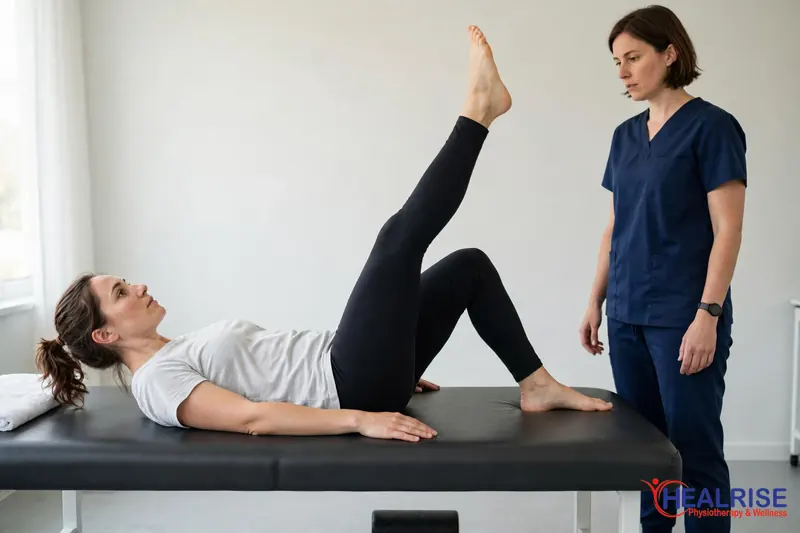
Straight leg raises: lying on your back with the other knee bent, tighten your thigh and lift the operated leg about a foot off the bed, keeping the knee straight. Lower it slowly.
Do these several times a day, little and often. They keep blood moving, reduce swelling, and wake up the muscles that support your knee.
Strength Exercises: Weeks 2 and Beyond
Mini squats: holding a kitchen counter for support, bend your knees slightly and straighten again, keeping your knees in line with your toes.
Step-ups: step up onto a low step with the operated leg, then step down slowly and with control.
Bridges: lying on your back with knees bent, lift your hips up and squeeze your glutes, then lower slowly.
Hamstring curls: standing and holding a chair, bend your operated knee to bring your heel toward your buttock.
Calf raises: rise up onto your toes and lower slowly, holding a counter for balance.
Leg press: in the clinic, pressing a light weight with both legs, progressing the load as your strength tests improve.
Balance and Control Exercises
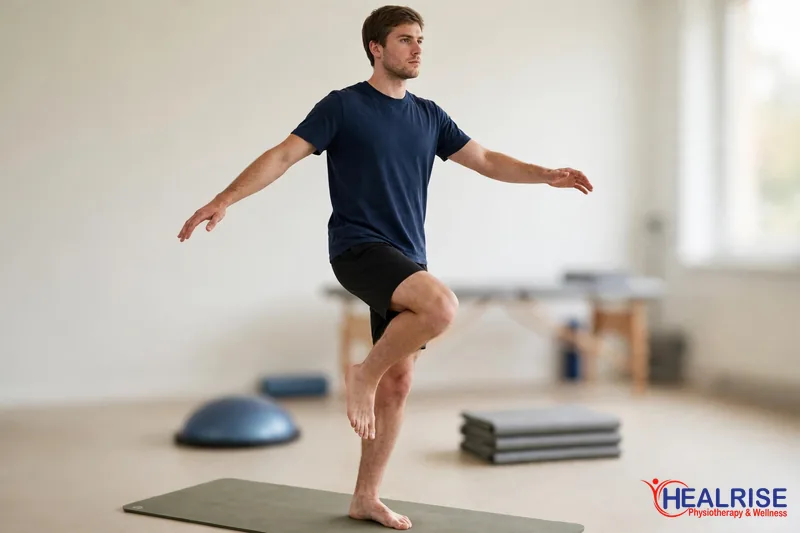
Single-leg standing: stand on the operated leg for 30 seconds, keeping your hips level. Progress to closing your eyes or standing on a cushion.
Balance board: gentle weight shifts side to side and front to back, keeping the knee soft and controlled.
Landing practice: later in rehabilitation, your physiotherapist teaches you to land softly from small jumps, with knees bent and in line with your toes. Good landing mechanics protect the knee more than almost anything else.
Only do the exercises your physiotherapist prescribes for your stage. Mild muscle ache after exercise is normal. Sharp pain, a sudden increase in swelling, or a feeling of the knee giving way means you should stop and call your physiotherapist. Runners with knee pain often have a different problem altogether; our IT band syndrome treatment in Morinville guide explains that condition and how it differs from an ACL injury.
Pre-hab: Strengthening Your Knee Before Surgery
If surgery is planned, the weeks before the operation are not wasted time. Pre-hab, or pre-surgery strengthening, can improve your recovery in a real way. Patients who go into surgery with a stronger quadriceps and a fully straight knee tend to recover faster and regain movement sooner afterward.
A typical pre-hab program lasts about three weeks and includes quad sets, straight leg raises, heel slides, stationary cycling, and balance exercises, all at a level your knee can handle. The goal is simple: reduce swelling, restore full extension, and build as much strength as possible before the operation.
Pre-hab is part of ACL rehabilitation Morinville care at Healrise, and we coordinate with your surgeon so your program matches their plan. If you decide against surgery, pre-hab simply becomes your rehabilitation program, and you continue building strength and stability without an operation.
Returning to Sport: The Tests That Decide When You Are Ready
Every ACL rehabilitation Morinville plan at Healrise is criteria-based, which means you return to sport when your knee passes tests, not when the calendar says so. This matters, because returning too early is the biggest risk factor for tearing the ACL again.
Before full return to sport, your knee must pass these checks:
- Quadriceps strength at least 90 percent of the other leg, measured by your physiotherapist.
- Hop test battery: a series of single-leg hops where each test must reach at least 90 percent of the other leg.
- Good movement quality: your knee stays in line with your toes when you land, squat, and cut.
- Full range of motion, with no swelling after training.
- Psychological readiness: you trust the knee again and feel confident in your sport.
Research shows that each month you delay your return to pivoting sport, up to nine months, reduces your risk of re-injury. Nine months is a safer minimum for soccer, basketball, hockey, and skiing than six. That wait is frustrating, but it protects the knee you worked so hard to rebuild. For how rehabilitation after ACL reconstruction is phased and why returning too early raises the risk of re-injury, see Johns Hopkins Medicine.
Our sports injury physiotherapy in Morinville program handles the final stage of this process, including sport-specific conditioning and the strength and hop testing that clears you to play.
Common Mistakes That Slow Down ACL Recovery
Skipping physiotherapy appointments once the pain fades. Pain fading is not the same as healing. The knee is weakest at three to six months, exactly when many people feel good enough to stop coming.
Stopping home exercises. Your clinic sessions guide the program, but your home exercises do the daily work. Missing them slows strength gains week after week.
Returning to sport too early. The knee may feel fine jogging in a straight line, but cutting and pivoting are different. Passing your tests first is what keeps the new ligament safe.
Ignoring swelling. A knee that swells after training is telling you the load was too much. Tell your physiotherapist and adjust, rather than pushing through.
Comparing your timeline to someone else’s. Age, graft type, meniscus damage, and pre-injury strength all change the timeline. Your plan is yours.
Training through sharp pain. Muscle ache is normal; sharp joint pain, locking, or giving way is not.
Neglecting the other leg, the hips, and the core. ACL rehabilitation Morinville is a whole-body program. Weak hips and a weak core change how you land, and that puts the knee at risk.
Ankle sprains are the most common sports injury we treat alongside ACL tears, and early care matters just as much there. Our ankle sprain physiotherapy in Morinville guide explains what to do in the first days after a sprain.
Pain, Swelling and Sleep: Managing the First Weeks
Pain and swelling are normal after an ACL tear and after reconstruction surgery. Ice is your best friend in the first two weeks: 15 to 20 minutes, several times a day, with a thin cloth between the ice and your skin. Keep the leg raised on pillows above heart level whenever you rest, and use compression if your physiotherapist advises it. Take your prescribed pain medication as directed, and do not stop it suddenly without advice.
Sleep is often the hardest part. Try sleeping on your back with the leg slightly raised on pillows. If you sleep on your side, a pillow between your knees keeps the leg comfortable. Avoid sleeping on your stomach in the first weeks, as it can twist the knee.
Driving is a common question. Most people can drive again once they are off strong pain medication, the knee bends enough to work the pedals, and they can react quickly in an emergency. For the operated leg, that is often around two to six weeks, but only when your surgeon and physiotherapist agree it is safe. Never drive while taking medication that makes you drowsy.
After any knee surgery, post-surgery physiotherapy in Morinville follows the same step-by-step approach as ACL rehabilitation Morinville, with the plan adjusted to your surgeon’s protocol and your goals.
ACL Rehabilitation Morinville: What to Expect at Healrise
At Healrise Physiotherapy and Wellness, your first visit for ACL rehabilitation Morinville is a full one-on-one assessment with a physiotherapist, not a quick screening. We test your range of motion, your strength, how you walk and move, and how the knee handles load. We ask about your sport, your work, your goals, and your surgery date if you have one. Then we build your plan and explain it in plain language, so you know what each phase is for and what has to happen before you move on.
We work with your surgeon, not apart from them. If you have a surgical protocol, we follow it. If you are deciding about surgery, we give you honest information about both paths so you can choose with confidence.
Practical details that make recovery easier: we are open seven days a week, so appointments fit around work and school. No referral is needed. We offer direct billing, and we handle WCB and motor vehicle accident claims. Walk-ins are welcome, and you can book online. Our clinic is at 10507 100 Ave, Unit 101, Morinville, Alberta, and our phone number is 587-485-0787.
Frequently Asked Questions About ACL Rehabilitation
How long does ACL rehabilitation take?
Full rehabilitation usually takes 9 to 12 months. Daily activities often feel normal by 6 to 9 months, but pivoting sport needs the full timeline, because the graft is still maturing and the knee needs strength and hop testing before it is safe to return.
Do I need surgery for a torn ACL?
It depends on your knee and your life. People who play pivoting sports, whose knee gives way in daily life, or who have meniscus damage usually need reconstruction. People with a stable knee and a less demanding lifestyle can often do very well with physiotherapy alone. Your surgeon and physiotherapist will help you decide.
When can I run again?
Straight-line jogging usually starts around four to five months, but only if your strength tests allow it. Agility, cutting, and pivoting come later, from six months onward, and full return to sport needs passing your strength and hop tests.
Can I walk normally after an ACL tear?
Yes. Most people walk again within days to weeks, with crutches at first and then without. A normal walking pattern usually returns by about six weeks with guided rehabilitation, though the knee still needs months of strengthening after that.
Will my knee ever feel normal again? For most people, yes. With a full ACL rehabilitation Morinville program, the knee becomes strong and trustworthy again. Some people notice small differences, such as stiffness in cold weather or a need to keep up with strength work. Most return to their sport and stay active for years. The patients who do best are the ones who finish the full program and keep up a maintenance routine for strength and control.
If you are ready to start ACL rehabilitation Morinville with a team that guides every step, call Healrise Physiotherapy and Wellness at 587-485-0787 or book online. We are open seven days a week at 10507 100 Ave, Unit 101, Morinville, and no referral is needed to book your first visit.
This article is general information only and is not medical advice. Always follow your surgeon’s instructions and your physiotherapist’s guidance for your own knee.