 by
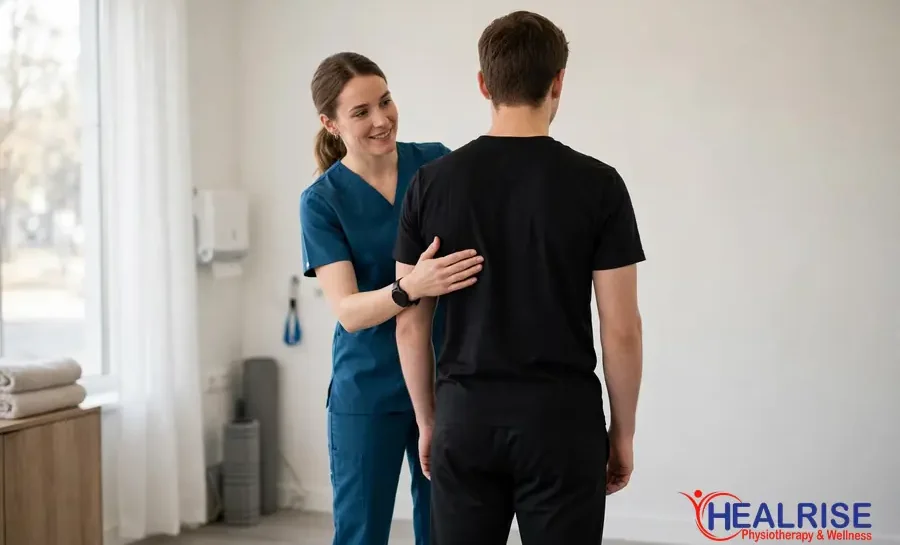
If you have noticed that one shoulder sits a little higher than the other, or your teenager’s T-shirt never seems to hang straight, you may be looking at scoliosis. Scoliosis is a sideways curve of the spine. Instead of running straight up and down, the spine bends into a C-shape or an S-shape when seen from behind.
It sounds scary, but here is the good news: most cases of scoliosis are mild, and many people with scoliosis live full, active lives. What matters most is getting it checked early and knowing what actually helps. At Healrise Physiotherapy in Morinville, we work with teens and adults with scoliosis every week. This guide explains what scoliosis is, the 7 signs to watch for, what physiotherapy can honestly do for you, and the simple exercises that support a healthier spine.
Table of Contents
What Is Scoliosis?
Think of your spine as a stack of building blocks. In a healthy spine, those blocks line up straight when viewed from behind. With scoliosis, the stack curves sideways, and the vertebrae often twist a little as well. That twist is why one side of the rib cage can look more prominent than the other.
Doctors measure the curve with something called the Cobb angle, taken from an X-ray. A curve of 10 degrees or more counts as scoliosis. Most people fall into the mild range (10 to 20 degrees) and may never need more than monitoring and exercise. Moderate curves (20 to 40 degrees) usually need closer watching, especially in growing teens. Severe curves (over 40 to 50 degrees) are less common and may need a brace or, in rare cases, surgery.
7 Signs of Scoliosis to Watch For
Scoliosis often develops quietly, without pain. That is why it is usually a parent, a coach, or a teacher who spots it first. Here are the 7 signs we tell families in Morinville to watch for:
- One shoulder is visibly higher than the other.
- One shoulder blade sticks out more than the other.
- The waist looks uneven, with more space on one side than the other.
- One hip sits higher or sticks out more than the other.
- The head does not sit centered over the pelvis.
- When your child bends forward at the waist with arms hanging loose (this is called the Adam’s forward bend test), one side of the rib cage or lower back looks higher than the other.
- Clothes never hang straight: hems look crooked, or one pant leg seems longer.
If you notice two or more of these signs, it is worth getting an assessment. A physiotherapist can do a quick, painless screening and tell you whether you need an X-ray or a doctor’s opinion. Early detection matters most for growing teens, because that is when curves are most likely to change.
Who Gets Scoliosis?
Scoliosis does not pick favorites, but some groups see it more often:
- Teenagers, especially girls between 10 and 15, going through growth spurts.
- Children with a family history of scoliosis (it tends to run in families).
- Adults over 50, as discs and joints wear down and the spine can start to lean.
- People who had mild, unnoticed scoliosis as teens and only feel it later in life.
Pain is not always part of the picture. Many teens with scoliosis feel no pain at all. Adults are more likely to feel aching in the back, stiffness after sitting, or fatigue from the muscles working overtime to hold the body upright. If you are dealing with ongoing back ache alongside a curve, our guide to back pain physiotherapy in Morinville covers how we approach persistent back pain.
How Scoliosis Physiotherapy in Morinville Works at Healrise
Every scoliosis plan at Healrise starts with a thorough assessment. We look at your posture from every angle, check how your spine moves, test your strength and flexibility, and review any X-rays you already have. If you have never had imaging and we think you need it, we will refer you to your doctor.
From there, we build a plan around proven, scoliosis-specific methods. The best-known approach is called the Schroth method, developed specifically for scoliosis. It uses three-dimensional exercises that match your individual curve pattern, combined with a special way of breathing (rotational breathing) that helps expand the compressed side of the rib cage. Our physiotherapists use Schroth-inspired principles tailored to each patient.
A typical plan also includes:
- Core and trunk strengthening, so the muscles around your spine can support it better.
- Postural training, teaching your body what “straight” feels like and how to hold it during daily life.
- Stretching for the tight muscles on the concave side of the curve, and strengthening for the weaker muscles on the convex side.
- Hands-on manual therapy and massage therapy in Morinville to ease the muscle tension and soreness that come with an uneven posture.
- A home exercise program you can actually stick to, because consistency matters more than intensity.
Because scoliosis changes how weight travels through the whole body, some patients also benefit from checking their foundation. Our custom orthotics in Morinville service can help when foot mechanics are adding extra strain to an already uneven spine.
5 Simple Exercises That Support a Scoliosis Spine
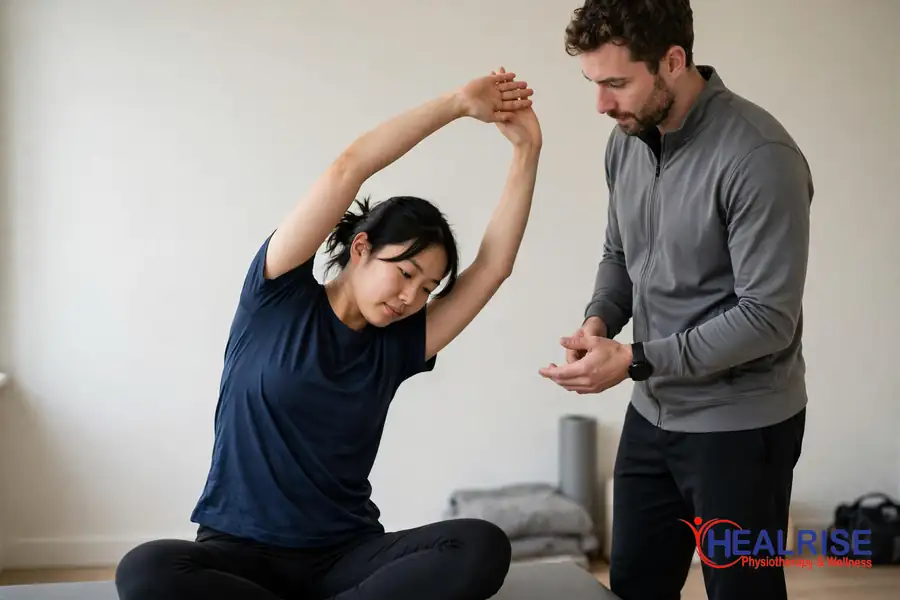
These are general, safe starting points, not a replacement for a personal assessment. Your curve pattern is unique, so some exercises may suit you better than others. Always check with your physiotherapist first.
- Chin tucks: Sit tall and gently draw your chin straight back, as if making a double chin. Hold 5 seconds, repeat 10 times. This wakes up the deep neck muscles and counters the forward-head posture scoliosis often brings.
- Wall angels: Stand with your back against a plain wall, arms in a “goalpost” position. Slowly slide your arms up and down, keeping contact with the wall. This opens the chest and strengthens the upper back.
- Side-lying leg lift (on the weak side): Lie on your side and slowly lift the top leg, keeping your hips stacked. This strengthens the hip and trunk muscles that help level the pelvis.
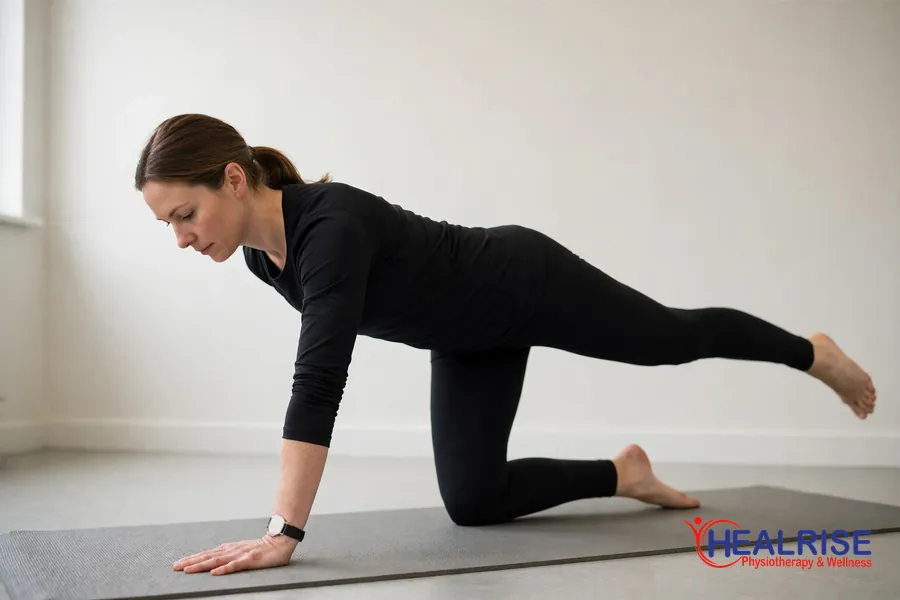
- Bird-dog: On hands and knees, extend one arm and the opposite leg, keeping your back flat. Hold 5 seconds per side, 8 to 10 reps. A classic for spinal stability.
- Prone press-up: Lie face down and gently press your chest up with your hands, keeping your hips on the floor. This extends the spine and relieves the ache of long sitting days.
Do these slowly and without pain. Mild muscle effort is fine; sharp pain is a signal to stop and tell your physiotherapist.
Bracing and Surgery: When Physio Refers You On
An honest guide has to say this: sometimes physiotherapy is not enough on its own, and that is okay. Knowing when to refer is part of good care.
- Bracing: For growing teens with moderate curves (roughly 25 to 40 degrees), a custom brace worn most of the day can slow or stop the curve from worsening during growth. We work alongside bracing, keeping muscles strong while the brace does its job.
- Surgery: Reserved for severe curves (usually over 45 to 50 degrees) that keep progressing or cause significant problems. This is a specialist decision, and we support patients before and after surgery with rehabilitation.
If either of these is on the table, we will tell you plainly and connect you with the right specialist. You can read more from the patient resources of the Scoliosis Research Society, a trusted source we often point families to.
FAQs About Scoliosis Physiotherapy
Can physiotherapy straighten my scoliosis curve?
Honestly, no. A structural curve will not become perfectly straight through exercise. But physiotherapy can reduce pain, improve your posture and appearance, strengthen your spine’s support system, improve breathing, and help you stay active and confident. For many people, that is life-changing.
Is scoliosis painful?
Not always. Many teenagers with scoliosis feel no pain at all. Adults are more likely to develop aching, stiffness, or muscle fatigue, especially after long days of sitting or standing. Pain that lingers is worth getting assessed rather than pushing through.
Can adults with scoliosis benefit from physiotherapy?
Absolutely. While we cannot change the curve itself in adults, we can reduce pain, improve posture and movement, build strength, and teach strategies that make daily life easier. Many of our adult scoliosis patients come to us for exactly that. If pain has become a constant companion, our chronic pain physiotherapy in Morinville program may also help.
Will my child need a brace?
Only some teens do. Bracing is usually considered for growing children with moderate curves that show signs of progressing. Mild curves are typically monitored with regular check-ups and exercise. Your physiotherapist and doctor will guide this decision together with you.
How often should we do the home exercises?
Most scoliosis programs work best with short daily sessions, around 15 to 20 minutes, rather than one long weekly workout. Consistency is what builds lasting change, and we design home programs to fit real life, not ideal life.
When should I see a doctor instead of a physiotherapist?
See your doctor promptly if there is rapidly worsening curvature, severe or night pain, numbness or weakness in the legs, or changes in bladder or bowel function. These are red flags that need medical attention first.
Book Your Scoliosis Assessment in Morinville
You do not need to figure out scoliosis alone. Whether it is your teenager’s recent school screening or your own back that has never felt quite straight, a proper assessment is the first step. At Healrise Physiotherapy, we will measure, explain, and build a plan that fits your life.
Call us at +1 587-485-0787 or visit us at 10507 100 Ave Unit 101, Morinville, AB. Let us help you stand taller, move better, and feel confident about your spine.