by
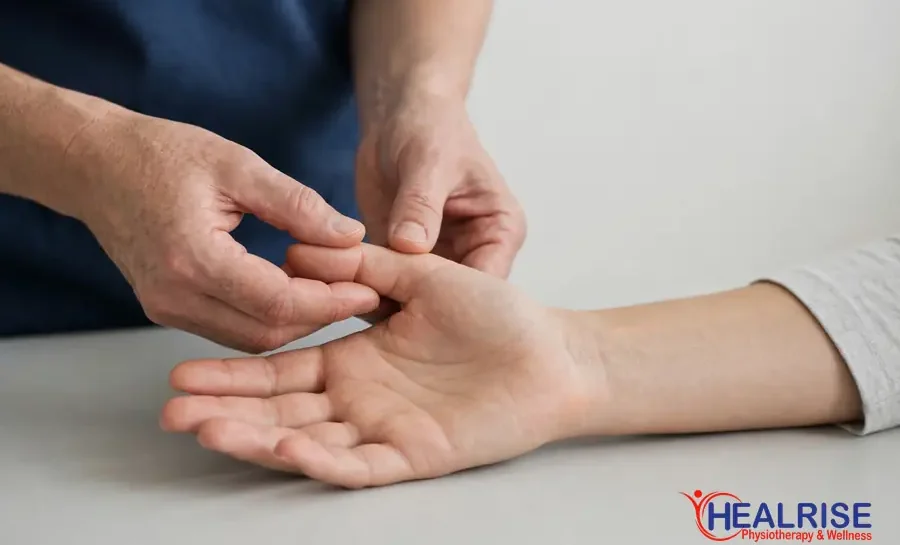
You curl your fingers to grip your morning coffee, and one of them sticks. You straighten it with a click, maybe a little pop, and it feels sore at the base. If this has happened to you, you may be dealing with trigger finger, and you are far from alone. Trigger finger physiotherapy in Morinville helps people understand exactly what is going on in that stiff finger and guides them toward the care that actually works.
Despite the name, it is not a joint problem but a tendon problem. This guide explains trigger finger in plain words: the five signs to watch for, who gets it, what physiotherapy can and cannot do, and when a doctor’s help is needed.
Table of Contents
What Is Trigger Finger?
Each finger has a tendon that bends it, like a cord pulling the finger closed. That tendon slides through a series of small tunnels, called pulleys, along the underside of the finger. Think of the tendon as a rope and the pulley as the rings the rope threads through.
When the pulley becomes inflamed and thickened, the tunnel narrows and the tendon has trouble gliding through. At first the finger just feels stiff or achy. As it worsens, the tendon catches on the pulley when you bend the finger, then snaps through with a click. In advanced cases the finger locks bent and you must pull it straight with your other hand. That catching and snapping, like pulling a trigger, is where the name comes from.
The medical name is stenosing tenosynovitis, but most people just call it trigger finger. The thumb is affected just as often as the fingers, and the middle and ring fingers are the most common culprits.
5 Signs of Trigger Finger That Call for an Assessment
Trigger finger tends to follow a familiar pattern. Watch for these five signs:
- Morning stiffness. The finger feels stiff or stuck when you first wake up, then loosens after you move it around for a while.
- A click or pop. You feel or hear a catching sensation when you bend and straighten the finger, especially at the base near the palm.
- Soreness at the base of the finger. There may be a tender bump or nodule on the palm side, right where the finger meets the hand. Pressing it hurts.
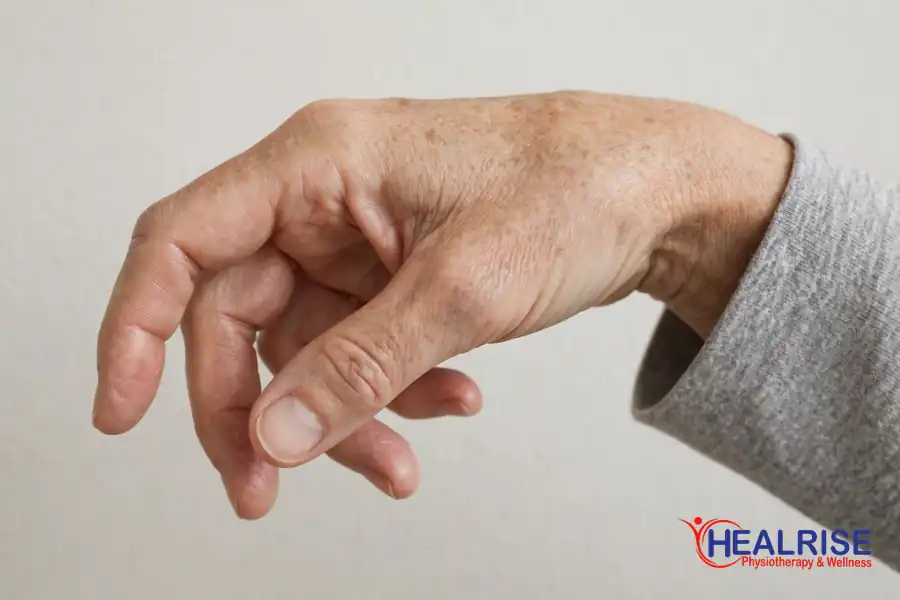
- Finger locking in a bent position. The finger gets stuck bent and will not straighten on its own, or straightens with a painful snap.
- Losing grip strength. Opening jars, turning keys, or holding tools becomes harder because the finger does not move smoothly.
Morning stiffness is the earliest and most common sign. Many people notice it for weeks or months before the catching starts. If two or more of these sound familiar, an assessment for trigger finger physiotherapy in Morinville is worth your time, because catching problems early gives you the most options.
Who Gets Trigger Finger?
Trigger finger does not pick people at random. It favors:
- People who grip hard, repeatedly. Anyone who grips tools, handles, or instruments for hours a day: tradespeople, mechanics, farmers, musicians.
- Women between 40 and 60. Trigger finger is more common in this group, likely due to hormonal changes that affect tendon tissue.
- People with diabetes. Diabetes is the strongest health link: up to one in ten people with diabetes develops trigger finger, and it tends to be more stubborn when blood sugar is not well controlled.
- People with arthritis. Both osteoarthritis and rheumatoid arthritis raise the risk, since inflamed joints go hand in hand with inflamed tendons. If finger joints already bother you, our arthritis physiotherapy in Morinville guide covers what helps there.
- People with other hand or wrist issues. Trigger finger often travels in the same company as carpal tunnel syndrome, another condition where hand structures get pinched and irritated.
None of these is required, though. Plenty of trigger fingers show up in people with perfectly ordinary hands and jobs.
How Bad Is It? The Grades of Trigger Finger
Not every trigger finger is the same. Doctors and therapists usually think in stages:
Grade 1: The finger is stiff and achy, especially in the morning, but it moves fully without catching.
Grade 2: You feel a click or pop when you bend and straighten the finger, but you can still move it on your own.
Grade 3: The finger locks in a bent position and you need your other hand to straighten it.
Grade 4: The finger is stuck, bent or straight, and cannot be moved back at all.
The grade shapes the plan: early grades respond best to conservative care, while locked fingers usually need a doctor’s treatment. Your first assessment sorts this out.
What Physiotherapy Actually Does for Trigger Finger
Here is the honest version, because this is where many clinics overpromise. Physiotherapy is a genuinely useful first step for trigger finger, especially in the early stages, but it works differently than most people expect. It is not about exercising the finger back to normal.
Care at Healrise for trigger finger physiotherapy in Morinville starts with a proper assessment: which finger is affected, how far it has progressed, what your hands do all day, and whether any red flags need a doctor. From there, the plan focuses on four things.
First, activity modification. Most trigger fingers are being provoked by something you do every day: a tool grip, a phone hold, repetitive pinching. We help you find those habits and change them, because a tendon that keeps getting irritated will not calm down.
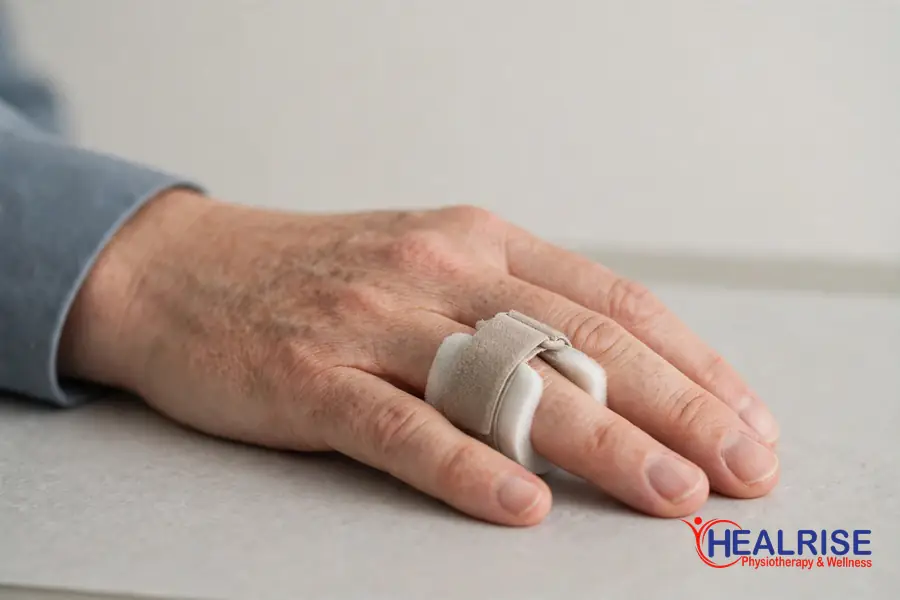
Second, splinting guidance. A simple finger splint worn at night keeps the finger straight while you sleep, preventing hours of repeated catching. For early-stage trigger finger, night splinting alone can settle symptoms within weeks.
Third, tendon-gliding education. We teach you gentle finger movements that keep the tendon sliding smoothly without provoking catching. These are easy movements, not workouts: the goal is mobility, not strength.
Fourth, hands-on care for the surrounding hand. Tight muscles in the palm and forearm can add to the irritation. Gentle manual therapy can ease that surrounding stiffness and make the hand work better as a whole.
What physiotherapy cannot do is shrink an already-thickened pulley with exercise alone. Alberta Health Services’ own clinical pathway for trigger finger notes that active exercises are not recommended as primary treatment and that the evidence for hand therapy is limited, with specialized hand therapy best suited to mild or early cases, or for people who prefer to avoid an injection. We tell you this upfront because an honest plan beats an expensive one that goes nowhere. For stubborn, long-standing tendon pain in other areas, we sometimes use shockwave therapy to restart healing, and you can read how it works in our shockwave guide.
When an Injection or Surgery Is the Right Call
There is no prize for avoiding the doctor when a medical treatment is the right answer. For trigger finger, the standard next step when conservative care is not enough is a corticosteroid injection near the affected pulley. It calms the inflammation directly, and one injection resolves the problem for a large share of people, especially in the earlier grades.
If the finger stays locked after injections, or if it is stuck in grade 4, a minor surgical procedure to release the tight pulley is highly effective. It is done under local anesthetic, takes minutes, and has a very high success rate. Some people choose to go straight to the injection without weeks of splinting first, and that is a reasonable choice too.
Our role is to assess your stage honestly, try the right conservative steps for early cases, and refer you to a doctor promptly when your finger needs more. If you are ever unsure which path fits your case, that is exactly what an assessment answers.
Home Care That Helps (and What to Avoid)
These simple steps are safe for most early-stage trigger fingers:
Rest the grip, not the finger. Keep the finger moving gently, but cut back on the heavy gripping that provokes it: power tools, prolonged phone scrolling, tight hand grips.
Use ice at the sore spot. Ten minutes of ice on the tender bump at the base of the finger, a couple of times a day, can settle irritation. Wrap the ice in a cloth; never press ice directly on skin.
Wear the night splint. If your physiotherapist fits you with one, wear it every night. This is the single most useful home measure for early trigger finger.
Keep it warm in the morning. Soaking the hand in warm water for a few minutes when you wake up loosens overnight stiffness.
What to avoid: forcing a locked finger straight with a hard yank, squeezing a stress ball or grip strengthener (it provokes the tendon, not heals it), and ignoring a finger that keeps getting worse. Repetitive forceful gripping is the opposite of treatment.
Warning Signs: When to Get Checked Soon
Most trigger fingers develop slowly and are not emergencies. But get assessed promptly if:
- The finger locks and you cannot straighten it at all
- The finger or hand becomes swollen, red, or warm
- You develop numbness or tingling in the finger
- The finger suddenly goes from working to stuck after a pop
- Pain steadily worsens over days instead of improving
A finger that is completely stuck deserves same-week attention, not a wait-and-see approach.
Trigger Finger FAQs
Can trigger finger go away on its own?
Sometimes, in the very early stages. Mild stiffness can settle if you catch and change the aggravating habit quickly. But once the finger is catching or locking regularly, it rarely resolves without proper care, so do not wait months hoping it will.
Do I need surgery for trigger finger?
Usually not. Most cases improve with conservative care, a corticosteroid injection, or both. Surgery is reserved for fingers that stay locked despite those steps, and it has a very high success rate when needed.
How long does a night splint take to work?
For early-stage trigger finger, consistent night splinting often brings noticeable improvement within 3 to 6 weeks. It works best when combined with activity changes. If there is no improvement after 6 weeks of faithful use, it is time to talk to your doctor about the next step.
Can exercises cure trigger finger?
Honestly, no, not on their own. Gentle tendon-gliding movements keep the finger mobile and are part of good care, but no exercise shrinks the thickened pulley that causes the catching. Be skeptical of anyone who promises that a workout program will fix it.
Is trigger finger related to arthritis?
They can overlap. Arthritis raises the risk of trigger finger, and both can cause morning stiffness in the hands. An assessment can tell them apart, because the treatment differs.
Should I stop using my hand completely?
No. Complete rest makes hand stiffness worse. The goal is smart use: keep the fingers moving gently, cut the specific gripping that provokes catching, and let the irritated structures calm down.
Book Your Trigger Finger Assessment in Morinville
A catching, clicking finger is your hand asking for help, and the earlier you answer, the more options you have. Trigger finger physiotherapy in Morinville at Healrise Physiotherapy and Wellness starts with an honest assessment: we will tell you what stage your finger is at, what conservative care can do, and when a doctor’s treatment is the smarter move. No doctor’s referral is needed, and we offer direct billing to most insurance plans.
Visit us at 10507 100 Ave Unit 101, Morinville, AB, or call +1 587-485-0787 to book. We are open 7 days a week, and walk-ins are welcome.